Tuesday, November 8, 2016

Wild Grapes

Riverbank Grape (Vitis riparia) is among the most common of our wild grapes.

     Wild Grapes (Vitis spp.) are an often misunderstood, but extremely valuable plant in our local woods. There are over 60 different species in North America, with 11 in Virginia, and 7 in the DC area. These woody vines can grow over 100ft in height and some varieties (granted in Europe) are known to live over 400 years. Most older vines have exfoliating bark and forked tendrils which help identify them. There are many species of birds that utilize the shredded bark to build their nests and many who favor nesting in the tangles themselves.
     There are many people who mistakenly think that grape vines are harmful to trees. Others mistake them for the invasive nonnative vine Porcelainberry (Ampelopsis brevipedunculata) which can smother and shade out native plants, and while removing it, accidentally destroy the grapes. One way to tell the difference is that Porcelainberry has white pith in its stems rather than the brown of grapes. 


Porcelainberry is easily mistaken for grape when not in fruit, but is not edible and is an invasive nonnative vine.

     Native grape vines are rarely damaging and will not kill healthy trees. They do not strangle and constrict the tree trunks (girdling them) like many nonnative vines who did not evolve with them actually do. Let's recall that if they really did kill off the native trees, they would have done so a long time ago. So these native vines get an undeserved bad rap and are actually a beneficial and integral part of the woodland edges.
     People have had a long association with grapes of course. Viticulture has been around and tied with civilization and even religion for centuries. When the Norse first reached North America there were so many grapes that they referred to is as Vinland. Survivalists know that cutting a section of vine can yield quite a bit of watery sap that can be used as an emergency water source. Parts of Virginia are well known for their domestic grape production and parts are definitely wine country. 


Muscadine Grapes (Vitis rotundifolia) or Scuppernong are among the biggest native grapes and is the most cultivated of the native grapes.

     Native American Indian tribes have of course always used grapes as well, not just for food, but for a multitude of other reasons. Noted ethnobotanist Daniel Moerman recorded many of these uses. The Iroquois for example used grape parts to treat anemia, stomach troubles, kidneys, urination issues, and even chewed the leaves to treat such mundane things as hiccups. The Menominee squeezed grapes to use as an eye wash. The Chippewa, Delaware, and Oklahoma all used it to wash hair (and some to treat pulmonary problems, diarrhea, rheumatism, and diabetes). The Mohegan, Seminole, and Shinnecock all used various grape species for dealing with headaches. The Cherokee thought parts of grape could deal with diarrhea, stomach ailments, liver problems, blood disorders, urinary irregularities, and even used the wilted leaves to draw soreness from breasts after birth. The Choctaw treated fevers with grape and used the sap to induce lactation in new mothers. The Seminole also used it for stomach aches, fevers, as a religious emetic, and as cordage for such things as coffin lashings. 
     During the Civil War, Dr. Francis Porcher was tasked with finding wild alternatives to goods no longer available to the Confederacy due to war and blockades. He did an amazing job compiling these uses. Most of his book entries were short and to the point, but he devoted several pages to uses for grapes. These included use as a dye, but he devoted most to the production of wine in great detail. 
      Animals of course make the most use of these native vines. While many mammals eat the fruits, helping to disperse the seeds, over 100 bird species have been documented eating grapes. They are a favorite of many of them. Another 79 caterpillar species have been documented using grapes as host plants to feed on, especially sphinx moths. These of course then feed many birds, 96% of which feed their young insects and preferring caterpillars over all others. All 17 of the bats found in the region also eat insects, and most favor the moths these caterpillars turn into as well.

The daytime flying wasp mimic Grapeleaf Skeletonizer Moth is one of the many that feed on grape. 

     I've eaten many a wild grape myself, knowing the best fruiting takes place along edges where the vine gets sun. They are much smaller than domesticated varieties and vary widely in flavor. Some, such as Frost Grapes, are much better tasting after they're hit by frost. Some are are tart and others sour, but I always enjoy trying them. So appreciate the wild grapes that grow in our parks and woodlands, knowing they have a rich history of uses by both humans and wildlife. 
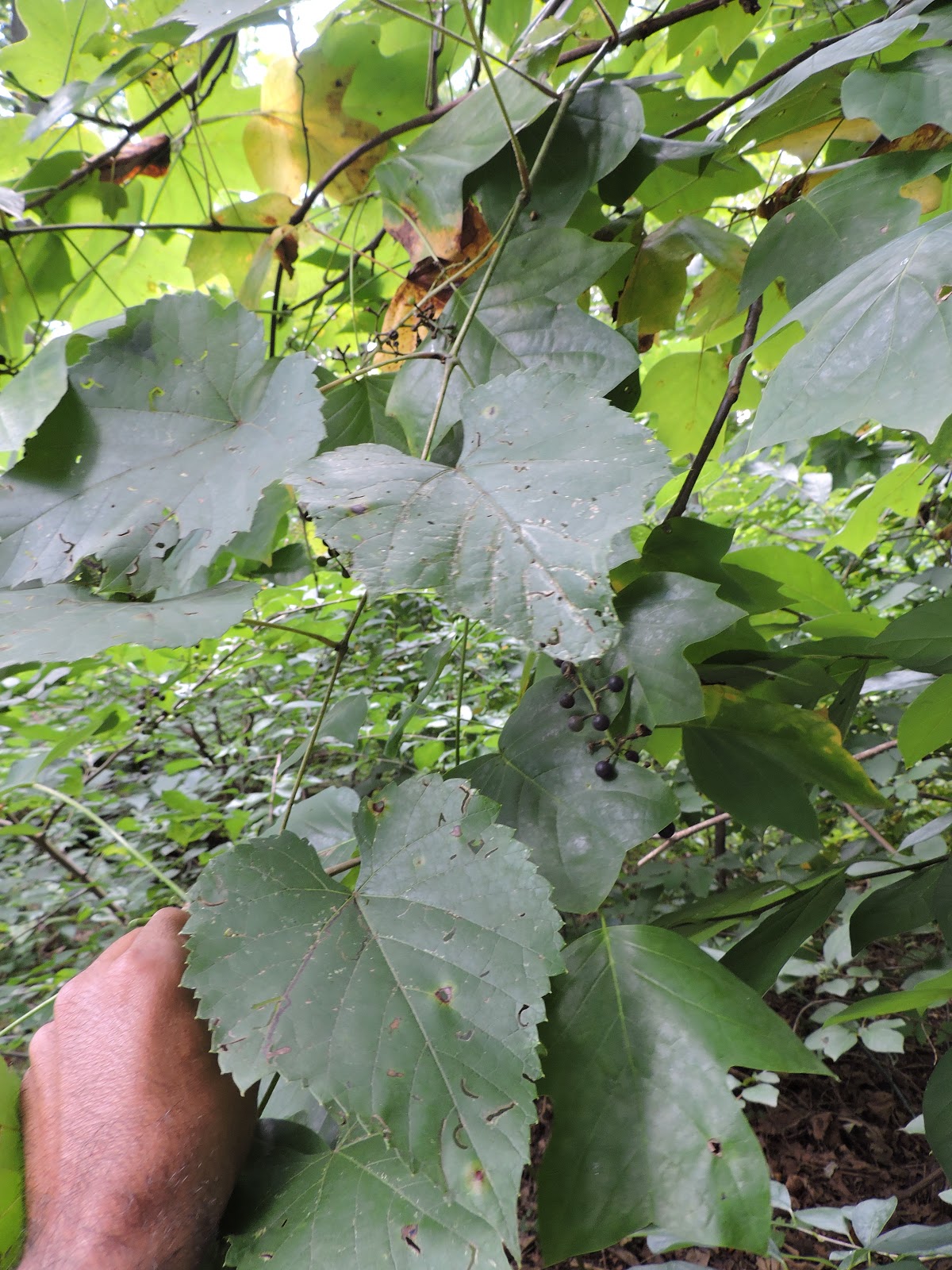

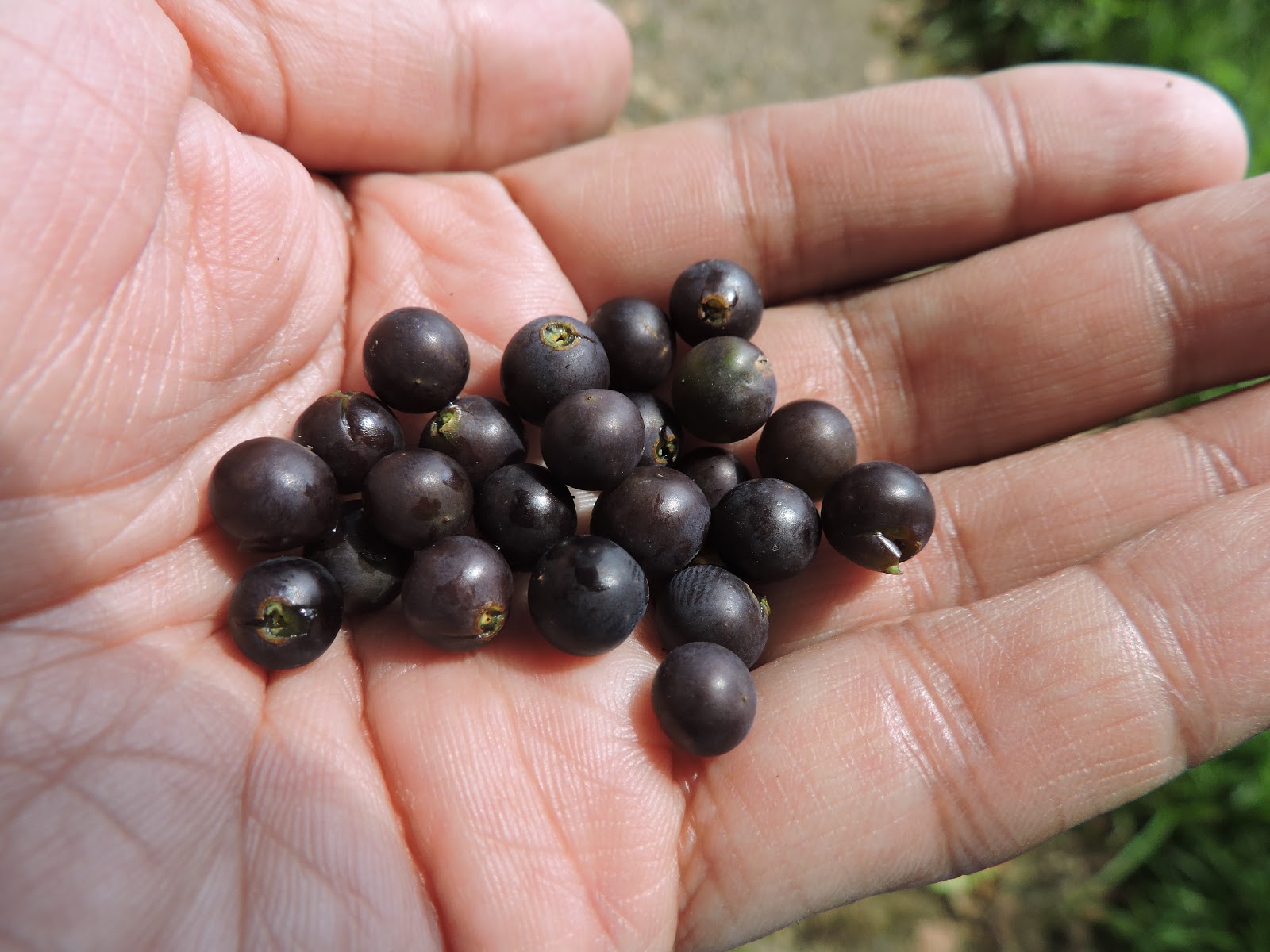
Frost Grape or Winter Grapes (Vitis vulpina

Frost Grapes taste much better after they've been touched by frost and can be eaten (even as wild raisins) even well into winter, giving them their other common name of Winter Grape. 

Saturday, November 5, 2016

Buck Moths


     So while waiting in my tree stand for a buck to show up, I noticed quite a few Buck Moths instead. These are quite different from most moths in a couple of ways. First they fly during the day rather than at night. Secondly, they come out during the late Fall when most moths have already completed their adult lives. 
     Buck Moths are called buck moths, some people say, because they come out during the deer rut when bucks are looking for mates. That was indeed true this day, as they were floating around right after the sun warmed the day enough from the frosty night before. Before flying, these moths, like many moths do, tremble and shiver, warming their flight muscles. They can operate in much lower temperatures than the vast majority of other moths. 
     The various species (our local version are Eastern Buck Moths, Hemileuca maia) are actually members of the Saturniidae, the giant silk moths such as Luna and Cecropia moths. Like most of them, the adults don't feed at all. Unlike most, the gregarious caterpillars are covered in stinging hairs. Early on they feed on various oaks, but later can feed on several other deciduous trees. Males are smaller than females, and males have reddish tips to their abdomens as opposed to the black tips of the females.
     When they encounter trouble, they often curl their heads under their body, lift their wings to expose their bright colored hairy bodies, and play dead. They can sit motionless for a good period of time in this position, until the danger hopefully goes away. Some believe they are distasteful to some predators. 
     
A Buck Moth plays "dead.
     I always love seeing these moths so late in the Fall, a reminder of warmer days. They flutter around in such an obvious fashion, that is until they think their lives are in danger and play dead. 


Monday, October 24, 2016

The Laugher or Marbled Tuffet Moth

The Laugher

     I love the names we give creatures sometimes. Take this caterpillar I found today. It is commonly called The Laugher, the larva of of what is sometimes also called the Marbled Tuffet Moth Charadera deridens. The name is derived according to stories from the adult moth having what looks like eyes and a smiling face on its wings. Others say that the caterpillar shows some vaguely grinning faces that change as the caterpillar matures, the grin growing smaller each time as the head capsule gets blacker. Even it's scientific epithet deridens comes from the French for "to deride, mock, or laugh at." 


     The Laugher is a hairy caterpillar with long setae (hairs) that are clumped together and emerge from each wart on its body. It's head capsule is very dark black when mature, but much lighter the younger it is, with 3 triangular tooth looking marks before it pupates. It can vary a bit in color, but is generally pale colored.
     This species usually has two broods or generations around here. It is adapted to being able to eat tough old deciduous leaves of trees, especially beech and oak, which most caterpillars often can't feed on. That's why you can find them often in the Fall when many other caterpillars have wrapped up their life cycles. This Noctuid moth overwinters as a lightly wrapped cocoon. 
     I've actually wanted to find The Laugher for quite a while. Even though its quite common, the most common of the 5 species in its Genus Charadera, I had never found one. That is until today. No joking, I was quite happy to finally find The Laugher, as was evident by the smile on my own face when I found it.


Sunday, October 9, 2016

Lion's Mane, Satyr's Beard, and Bearded Hedgehogs, Oh My...

Lion's Mane (Satyr's Beard) on a dying tree

     Fall rains often bring an explosion of mushrooms. One of my favorites is a distinctive one that goes by a variety of names: Lion's Mane, Satyr's Beard, Bearded Tooth Mushroom, Pom Pom Mushroom, and Bearded Hedgehog Mushroom among many others. In Japan it goes by the name Yamabushitake and is used in many Asian dishes.


The soft toothy projections that disperse the spores are fairly evident here

     Toothed Mushrooms disperse their spores by dropping them below their toothy fringes. It is considered edible, as I mentioned before, particularly in Asian vegetarian dishes. It is supposed to taste like seafood and substitute for it. I wouldn't go that far. I think it absorbs the flavors of what's around it and can add consistency and act as a soup thickener though. It shows up for sale sometimes in specialty shops and farmers markets. 


Diced and sliced

     It can come in various sizes. Our urban forester Vincent Verweij once found a huge one weighing several pounds in a tree that had to come down for safety reasons. That meant there was plenty for all of to share. My whole family agreed that it was delicious! Now it's something I hope to find every Fall.


Some sizzles in a pan in my kitchen

     Interestingly, some people are investigating it for supposed medicinal values. So far it is showing remarkable promise, some studies showing it can help improve memory, help with nerve damage, and improve other memory issues. Regardless of all that, I found it an interesting thing and tasty treat for my family.


Our urban forester Vincent Verweij with just a portion of a huge Lion's Mane from a tree that had to be taken down.
A small Satyr's Beard, with a Leopard Slug ready to feast on it too

Wednesday, September 28, 2016

Goldenrod Safari

A Goldenrod patch at my home

     This time of year, many people notice how abundant goldenrods are in our open areas. Since this coincides with many people getting hay fever allergies, they wrongfully blame the goldenrods they notice, rather than the ragweed and other real culprits that they don't. Showy flowers such as goldenrods have larger and heavier pollen that is transferred by pollinators such as insects. Wind pollinated plants do not need showy flowers since they need not attract any pollinators, but need to produce an abundance of light weight pollen in the hopes some of it is carried onto another flower. Those plants, especially ragweeds, are what cause the issues this time of year.
     Goldenrods are an important and abundant Fall flower. Many animals depend on them. We have close to 50 species in Virginia alone, so they're adapted to many growing conditions, but most favor open, sunny locations. Due to their adaptability and showiness, many goldenrods are garden staples, both here and in other countries. In some parts of the world however, due to their adaptability, North American goldenrods have the potential to become invasive. They have some allelopathic traits, exuding chemicals that inhibit the growth of certain plants (such as maples) that also help them compete.
     The Genus name "Solidago" translates to "making whole" and points to worldwide use of this plant group for many medical and other uses. In  North America, famed ethnobotanist Daniel Moerman listed too many uses by native peoples to cover here. I will mention just a few for one of the most common species, Solidago canadensis, Canada Goldenrod though: The Iroquois used it for such various things as treating body pains, using the roots as an emetic to induce vomiting, and even to assist in getting better luck, deeming it "gambling medicine" as did the Navajo. The Potawatami used the blossoms for dealing with fevers. The Zunis chewed the flowers when they wanted rid themselves of a sore throat. The Shuswap believed a bath made from goldenrods could assist a mother at childbirth. The Meskwaki believed it could be used as wash for children who did not talk or laugh. The Thompson used it for everything from treating diarrhea, to using it in steam baths for treating paralysis and cripples, to using it to treat cuts and sores on their horses.
     Francis Porcher, a Confederate doctor charged with finding local sources for medicines no longer available during the Civil War, also found uses for it. He wrote that it could be used for cordage, making usable rope. He also said it made for a medicinal tea and a valuable dye.
     In Europe, their species had long been used. According to folklorist Jack Sanders, it was greatly revered. He noted that herbalist Nicholas Culpeper called it a "sovereign wound-herb, inferior to none" and that English herbalist Donald Law deemed it "as much a panacea as any plant could be." More fanciful uses were attributed to it by diviners and witches. 
     Thomas Edison was a big believer in goldenrod use. He experimented and succeeded in making rubber from certain Solidagos. He even bred his own type that grew to twelve feet tall to maximize the rubber compounds. Henry Ford even gave him a Model T with tires made from his goldenrod rubber. 


European Honeybees make great use of goldenrods this time of year, benefiting us with honey.

     Of course, it is wildlife that have the most uses for goldenrods. In addition to feeding on the many insects that use Solidagos (see below), birds such as goldfinches, juncos, pine siskins, trukey, indigo buntings, and various sparrows all feed on the seeds. Despite the chemicals in them that made them such sought after medicinal plants, mammals such as rabbits, voles, mice, beaver, muskrat, groundhogs and deer (although others consider it deer resistant) all make use of it.
     Insects make the most use of them (and feed such things as birds and bats in the process). A study in 1996 found 103 species that fed extensively on Tall Goldenrod (Solidago altissima), while another on Canada Goldenrod (Solidago canadensis) in 1948 collected 241 insects on it over a year. Over 13 species of grasshoppers favor them, as do 16 bug species, 9 aphids, 7 leaf hoppers, and countless beetles (including 15 leaf beetles). Caterpillars numbering 115 different species have been documented feeding on goldenrods (and which then of course become the main prey of birds and bats). Tons of pollinators visit the flowers, including 7 bee species that are oligolectic, requiring that specific pollen in order to be able to reproduce. One species for example, Andrena solidaginis, even has Solidago as part of its name to show how necessary it is for its survival. There are several galls that are particular to goldenrods also. These in turn have certain resident and parasites that will also live in them.


Goldenrod Bunch Galls are caused by a specific gall midge, the Cecidomyd midge Rhopalomya solidagnis. Note that its scientific name contains the genus Solidago, showing how they live no where else.
The Goldenrod Round Gall is caused by the tephritid fly Eurosta solidagnis, in our area usually restricted to either Tall or Canada Goldenrods. One of these has been raided and now has a hole in it, likely helping to feed a chickadee or downy woodpecker over the winter.
Elliptical Goldenrod Galls are formed by 2 kinds of moths. This one is  open and so may have emerged already.


     As you can see, goldenrods are extremely valuable plants and deserve to be included in our gardens and landscapes, not simply because of their beauty and adaptability, but for the wonderful wildlife value they have. There was even a movement to make goldenrod our national flower in the late 1800's. It has had to settle for being the state flower of both Kentucky and Nebraska, and the state wildflower of South Carolina. 
     I thought that to show you just how much wildlife like them, I'd take you on a short "Goldenrod Safari" showing just a small portion of the common things you can find making use of a goldenrod meadow, especially this time of year. So enjoy:


Long-horned Locust Borer beetles, yellowjacket mimics, love goldenrod. They eat the pollen, pollinating it at the same time. They often kill 2 birds with one stone, mating while feeding on the goldenrod.
Daytime flying Ailanthus Webworm Moths are often found nectaring on Goldenrods.  More on them here: http://capitalnaturalist.blogspot.com/2014/09/ailanthus-webworm-moths.html.
Migrating Monarch and Buckeye Butterflies (such as this one) find goldenrod blooms to be life savers on their travels.
Several very similar looking wasp mimic moths are commonly found sipping nectar on goldenrods, such as this Yellow-collared Scape Moth.
Numerous Syrphid or Flower Flies favor goldenrods, most being excellent bee and yellowjacket mimics.
Bees love goldenrods, like this bumblebee and its larger carpenter bee cousin.

     So the next time you pass a Goldenrod patch, do more than smell the flowers (though you can at least do so with out fear of allergies). Stop by and conduct a little safari, trying to see how many different animals are using them. 

Wednesday, September 14, 2016

Bald-faced Hornets


     Bald-faced Hornets (Dolichovespula maculata) have a mostly undeserved reputation for being vicious, pests and safety hazards. They are actually fairly beneficial insects with a role in the environment. Sometimes called White-faced Hornets, Bull Wasps, or Blackjackets, these wasps are actually not true hornets, but large aerial yellowjackets. 
     They mostly go unnoticed and cause no issues until suddenly someone becomes aware of their large paper nests and get scared. Now these insects, which have been living in that same place throughout the earlier part of the spring and summer causing no trouble, are seen as a danger and something to be feared and destroyed.

The typical paper nest we often do not notice until late in the season or when the leaves have fallen from the trees.

     Most of the time, Bald-faced Hornets are actually beneficial. They hunt other insect prey (including some pests) and bring them to feed themselves and their developing young. They predate on quite a few insects, considering that a nest can hold 400-700 workers by the end of the season. Interestingly, one of their favorite food items are their smaller cousins, Yellowjacket wasps. They also serve as minor pollinators (particularly late in the season when they visit more flowers to obtain nectar and hunt less since they have less young to feed). 

A Bald-faced Hornet worker visits a plum flower.

     A typical nest starts when an overwintering queen wakes up in the spring and finds a likely location to start her nest. Though most of the time they choose a location in a tree from 2'-60' high, they sometimes will use the eaves of a building or other structure that might give some cover from the elements. The queen chews some wood fiber, mixes it with saliva, and then shapes it into the first hexagonal paper cells that will house her eggs. Each egg takes about 6 days to produce young. She feeds and cares for these, who then become the first workers and will raise, provide, and protect the young until the end of the season. A new paper nest is quite small and has the opening at the very bottom.

A small paper hornets' nest at the beginning of the spring.

     The queen then has the sole duty of laying eggs for the rest of her life. The workers (all female) hunt for prey, raise the young, build, repair, and protect the nest. They add new layers and hexagonal cells until the nest attains the size of a basketball, though some are up to 2' long. The opening often ends up near the bottom but slightly off to the side. It is at this stage that many people notice and start to be fearful of the nest. Bald-faced Hornets, though not vicious, will certainly defend their nest. They will each sting repeatedly any perceived threat to their young. Unlike other wasps, they are also capable of squirting venom often aimed at the face of an intruder, and which can even temporarily blind. Here's a short video of a nest and its guards:

                              https://www.youtube.com/watch?v=X3HVOckYGsY

     By late summer or early fall, the queen starts laying male (drone ) and future queen eggs. Unfertilized eggs become male. The new queens tend to be larger and are hairless (unlike the female workers who have very short "hair" (setae)). Egg production starts to taper off, and eventually there are no more workers or reproductive eggs laid. The old queen dies (some say that in some cases, the workers kill the no longer useful queen). All but the new queens after mating will eventually die off, usually by the time they get a couple of hard frosts. The old nests are durable, easily visible in the winter when the leaves are not around, but start to rot away, with no workers to repair or lap them dry after storms. Nests (except maybe a very few in the deep South) are not used again.

An overwintering Bald-faced Hornet queen.

     The new queen finds a sheltered location to overwinter, often under bark or logs. She will remain in this state (called diapause by some) until mid spring of the following year when she finds a new nest location and starts the cycle all over again. Here's a short video of one I discovered under a log that was overwintering:

                              https://www.youtube.com/watch?v=3JdiA-Ozddw

     Sometimes nests do become a safety hazard where they might cause issues with people. This is normally when the nest is too close to habitation or where people can bump into them. When this happens, the nests do need to be destroyed, as they cannot be safely moved. This is best done by a professional. If someone does decide to try and eliminate a nest on one's own, please do so with caution and not use such ridiculous tactics as burning them. This should be done at night (when they're all home, sluggish due to lower temperature, and trapped inside) using one of the commercial hornet sprays. A flashlight may help to find the nest initially, but should be placed away from the person spraying or turned off so as to not give the workers a target if they come out in defense. The spray should be aimed directly into the opening, not only to get the pesticide inside and not hit unintended targets, but to also to help prevent them coming out against the stream of the nozzle. 
     Most of the time, these insects should be left alone however. They are beneficial and will leave people alone as long as they don't perceive them as a threat. This year, perhaps because of environmental conditions, we seem to have more nests around than other years. The nests I seem to be finding are much lower down than I typically find also. Old country lore claims that you can foretell the severity of snow by observing how low hornet nests are. The lower the nests are, so it is told, the more snow we will get. There doesn't seem to be any scientific reason that this would work, as the hornets are dead long before the snows arrive and so it doesn't matter where they choose to build, but if this is somehow true, we're in for a really deep snow from what I've noticed this year...

Thursday, September 1, 2016

Walnut Caterpillar

A Walnut Caterpillar. You may be able to notice where it spit up on my hand.

     The Walnut Caterpillar (Datana integerimma) is a neat caterpillar with a mixed reputation. One of 13 species of what are sometimes called the Handmaid Moths, the Genus Datana, they can be difficult to tell apart. They all are very social, at least while young caterpillars, forming large groups. When disturbed they also all have an interesting defensive posture. They all in unison lift both ends of their bodies and arch themselves upwards. They may also regurgitate onto anything that attempts to grab them. Older caterpillars sometimes just let go and fall to the ground.

A Walnut Caterpillar starting to give the typical defensive posture of the Datana moths.

     The Walnut Caterpillar is much easier to tell apart than the others, lacking much of the markings the other members of the family have that make them all look so similar. They do indeed feed on walnuts, hickories, and pecans (some claim they feed on a few other species, but that's debatable). This can lead to their being considered agricultural pests, though that's more of an issue in the South where they can have multiple broods and defoliate production trees. In our area and further North, they only have one brood and so usually are not as much of a problem and the trees recover well. They are also a favorite food of many animals, so their numbers are usually kept in check. 
     These caterpillars have what maybe a unique behavior as well, that even other members of their Genus lack. They all molt, shed their skins each time they grow, in unison. Even caterpillars born at different times and of different sizes, all somehow synchronize it so they all shed their skins at the same time and in the same place. This usually results in a huge pile of caterpillars and then left over skins, in what may resemble a big hair ball, in the crotch of the tree.

The remains of the synchronized molt of the Walnut Caterpillars in a black walnut tree.

     As quickly as they seem to have appeared, they all seem to disappear. The last instar (molt) crawls to the ground and pupates underground, starting the process again the next summer.