Thursday, March 31, 2022

Jack-in-the-pulpit


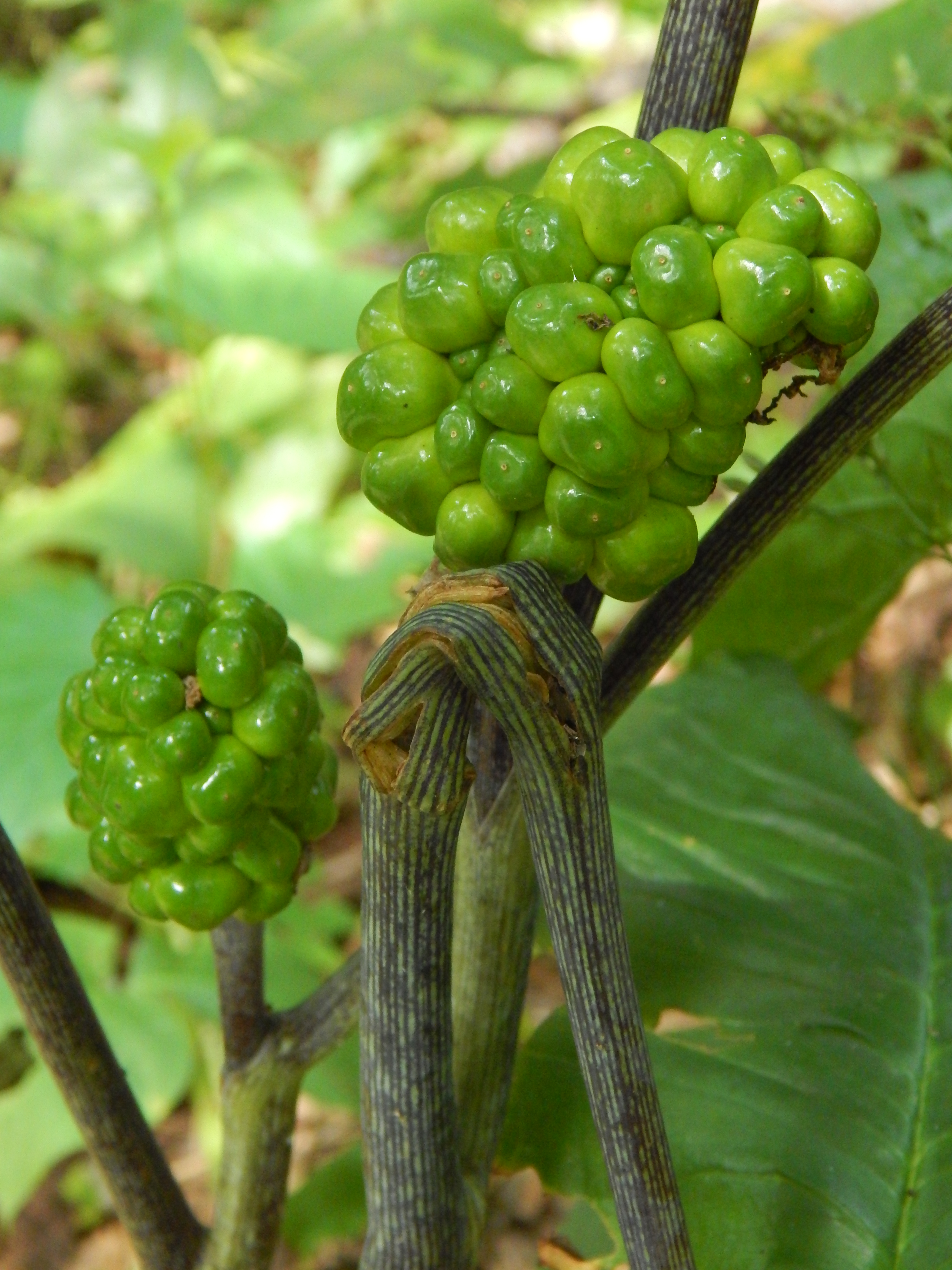
          Jack-in-the-pulpit (Arisaema triphyllum) has over 30 common names: Indian Turnip, Wild Turnip, Marsh Pepper, Pepper Turnip, Bog Onion, Brown Dragon (due to the burning taste of the raw plant), Dragon Turnip (due to its turnip-shaped corm), Starchwort, Wake-Robin, Dragon Root, Marsh Turnip, Swamp Turnip, Devil’s Ear, Priest’s Pintle, Indian Cradle, Memory Root, Cuckoo Plant, Three-leaved Arum, Parson-in-the Pulpit, Lady-in-a-Chaise, Lords-and-Ladies, and Cuckoo Pint to name a few. Some authorities recognize 3 species and others simply lump them into one (as if there wasn’t enough confusion with the common names). It’s most common name stems from the flower structure: the “jack” is the spadix or club-like part who stands within the pulpit which is the spathe or curved cover or hood overtop. It ranges from Canada to Florida, west of Kansas. The flower color can be quite variable, especially being yellow or dark striped.

One for the various shades of Jacks.

            The plant is a member of the Arum family (a word that gets its meaning from an Arabic word for “fire”) and as such protects itself by producing calcium oxalate crystals. These crystals can cause a severe burning sensation if it’s eaten raw. It can cause mechanical damage as well. Some people even get skin irritations or blisters from skin contact with it. It use to be a country trick to try and get someone to bite it and suffer the consequences. There is even a story of a Meskwaki tribe who got its revenge on the larger Lakota (Sioux) tribe by inviting them to dinner and then feeding them raw jack-in-the-pulpit in the meat (and then attacking them when they were in great discomfort). Some people have even died from swollen throats after ingesting it. While birds and others can eat the bright red fruits, it can cause issues with people. When we process the seeds for planting, we usually wear gloves and make sure not touch our faces or eyes. 

All parts of the plant, including the green berries, are toxic raw.

            Having said that, a few of its common names point to its edible uses. When thoroughly dried (6 months or so) and roasted, it was eaten like potato chips or made into a flour (which reportedly has a chocolate-like taste).

A Jack with the two stems that denotes this as a female plant.


The ripe fruits turn red and are quite attractive, though still toxic to humans.

  It was also used quite a bit medicinally. North American tribal ethnobotanist Daniel Moerman lists many varied uses: The Cherokee used it for skin diseases, for flatulence, for colds, for intestinal worms, and for boils. The Chippewa (as well as the Menominee and Ojibwa) used it as an eye medicine. The Iroquois were said to even use it as contraceptive along with treating headaches, bruises, sores, fevers, and children’s diarrhea. Interestingly, instead of using as a contraceptive, they used it induce pregnancy in horses. The Pawnee likes to use the seeds in their gourd shells to serve as rattles (as well as for headaches and rheumatism). Some tribes had to ceremoniously eat the raw leaves as an entrance into manhood. During the 16th and 17th century, people used starch made from the roots as a stiffener for clothes, thus the name Starchwort. The bright red berries were also used to make a red dye. During the Civil War, the Confederate states were blockaded from getting most goods. So they tried to find alternatives especially in food and medicines. The person in charge of compiling all of this was Dr. Francis Peyre Porcher who compiled a manuscript entitled the "Resources of the Southern Fields and Forests, Medical, Economical, and Agricultural Being Also a Medical Botany of the Confederate States" commonly referred to as the Confederate Ethnobotany. About "Wake Robins", as he called them as they often open when robins are nesting, he compiled several uses. He described how mixing the fresh roots with honey or syrup could be used for sore throats, particularly in children. He said it was also useful in treating rheumatism and a concoction of the sliced roots for poison ivy. He also described its use for an expectorant, for treating ringworm, skin diseases, in addition to it being used for making bread. 

These young Jacks are many years from producing any flowers, and even more so from producing fruits. At this stage many people misidentify them as trilliums or even poison ivy. 
            This plant has an interesting development in that it can change sex throughout its life. When it first starts growing, it doesn’t produce any flowers. As it gets larger and stores enough nutrients, it will start producing male flowers, have one leaf stalk with three leaflets and be small in size. The flowers on these have a small opening at its base that allows pollinators (often fungus gnats or other small creatures attracted to rotting flesh smells) to escape. Once it builds-up its store of nutrients, it can finally invest in a larger, female flower with two stalks with three leaflets that lacks the opening at the base of the flower. If pollinated, this may then sap so much energy from it that it may revert back to the “cheaper” male plant. This cycle is referred to as sequential hermaphroditism. They can live for 20 years so are a long-lived plant. 


Sunday, March 27, 2022

Common Blue (Confederate) Violets


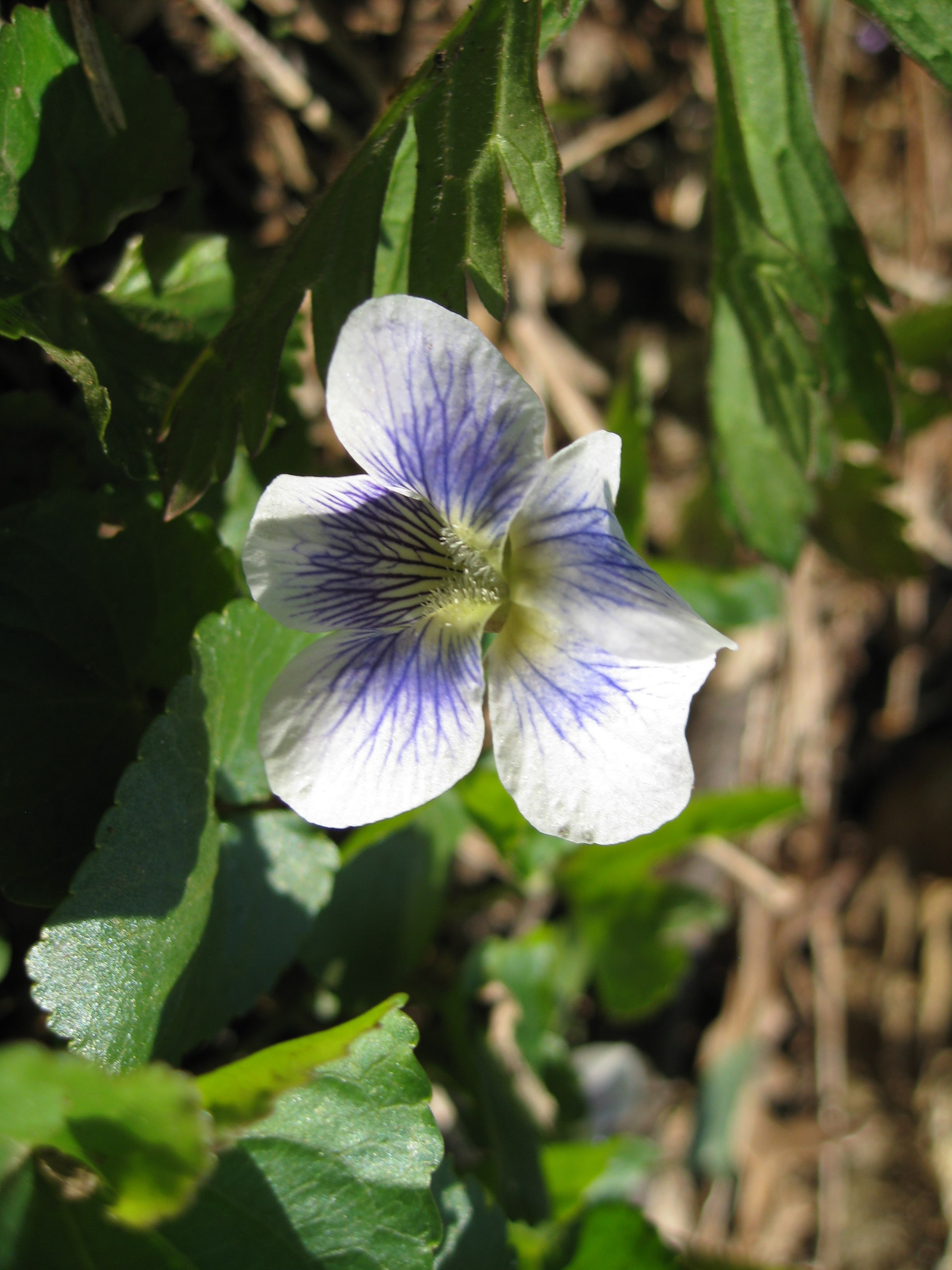
Common Blue or Confederate Violets 

    So the Common Blue (Confederate) Violet (Viola sororia) is so routinely seen in our yards that they are often ignored. They however have some interesting natural history and folklore tied to them. Indeed much of what follows can also be applied to the other 36 or so species found in both Virginia and Maryland as well. 

    First off, some folklore of violets in general. Violets are said to be the symbol of Athens, as the legendary founder Ion was given violets by nymphs when he arrived at the future place for the city itself. Indeed the common for violets in Greece is usually thought of to be Io. The connection to Greece also goes back to several legends concerning their gods, which were subsequently also applied to Rome. The king of the gods Zeus (Jupiter in Rome) was said to have fallen in love with a beautiful maiden called Io (Viola in Rome). In other versions she is a magical nymph, the daughter of a river god and King Argos. Regardless, Zeus (Jupiter) was constantly after her and tricked her into making love to him. His wife Hera (Juno in Rome) found out about this affair. This was particularly bad as Hera is the goddess of marriage and she wanted to teach the maiden a lesson that would be passed on to all mortals. Here the story differs even more depending on who tells it, but in all of them, Io (Viola) ends up losing. In one version, Hera (Juno) catches up to the mortal and changes her into a white heifer with gadflies biting her until the end of days, and Zeus (Jupiter) was unable to do anything about it. Her tears became the violets. In another version, Zeus (Jupiter) finds out that Hera (Juno) is jealous and angry and so he changed Io (Viola) into a cow, as what Hera has planned would have been so much worse and so she can't find her. Here either her tears turn into the violets, or Zeus (Jupiter) makes the violets appear so she can have something beside grass to eat. No matter what version, Io (Viola) is the ultimate loser. 

    In Rome, people saw the violet as a symbol of innocence and modesty, and would often lay violets on children's graves. Romans also thought that wine made from violet blossoms meant that you could not get drunk. Other Romans used it to prevent hangovers. Medieval Christian folklore believed that the flowers sprung from Adam's tears. Other medieval Christians believed that the flowers of violets once were tall and stood upright, but that changed on Mount Calvary where Jesus was crucified when the shadow of the cross fell on them. Ever since violets have bowed in shame of being present in such sad events. It has been traditional to use the flowers in Good Friday decor around Easter since then as well. Violets are also said to be Mohammed's favorite flower.

Common Blue Violet
    Violets are also said to be a symbol of the Bonapartist movement. Napoleon Bonaparte was said to carry violet flowers with him in his pocket in a locket. It was said that once he was captured and exiled, that he would "return with the violets' of the spring." It was also said to be his wife's favorite, used for their wedding, anniversaries, and finally on her grave. Napoleon was sometimes called "La Coporal de Viollette." His followers used the plant as a code and symbols for their communications. The pansy, a cultivated variety of violet, is said to come from the word "pensee" meaning thought and sentiment. Indeed violets have over 200 common names relating to love and sentiment. 

    Violets also have some other traits in common. Most violets are Myrmecochorous, meaning that seeds have an attachment called an elaiosome that some species of ants find delectable. They then take the seeds to their nests, eat the elaiosome, and discard the seed into their waste areas, planted below ground and guarded by ants. Ants therefore are the main seed dispersers. For more on this interesting way of spreading seeds see my Capital Naturalist Blog here: http://capitalnaturalist.blogspot.com/2014/04/myrmecochory-ants-in-our-plants.html

    For many violets, including the Common Blue (Confederate) Violet, they also have another reason they're so common. The flowers are easy to see when they're in bloom for pollinators to find. These showy blooms are said to be Chasmogomous, Greek for "open marriage" with the petals highlighting around the pollen-bearing open flower head. However, especially early in the season, pollinators may still not find these flowers to pollinate. Therefore, especially for those spring blooming early species, they hedge their bets by producing Cleistogomous flowers. This is Greek for "closed marriage" and involve flowers that never open. These instead self pollinate, which while not great for genetics, does mean they will always produce seeds for the ants and to germinate. These are usually low to the ground and near the main stem, as they have no need for any pollinators to spot them. This is one reason why some species of violets are so common in our yards. 

A Variegated Fritillary laying eggs on Common Blue Violet
    Violets are said to host 30 caterpillar species, including many of our Fritillary butterfly species. By naturally having their flowers pointing downwards, they protect their chasmogomous flowers from the rain and losing of pollen. Now our Common Blue Violets come in some various color forms. This includes the Confederate form which is commonly found growing side by side with the more common blue colored ones. They are one and the same violet species. 

A Confederate Violet, just another color form of the Common Blue Violet

    Violets are edible, both the leaves and the flowers. Most prefer to eat the blue colored or perhaps white colored ones over the yellow colored ones, some saying these are much more tasty. The flowers add color to salads and most say are better tasting than the leaves. But both leaves and blooms are full of Vitamin C and A. The blooms are often candied or added as a garnish and are pectin rich. These are more often used in syrups, brews, teas, wine, and salads. Having said that, the leaves especially are full of saponins and when eaten in excess can lead to digestive issues. 

    Herbalists have used violets for insomnia, epilepsy, pleurisy, ulcers, eye inflammation, rheumatism, as a laxative, as cough medicine, pain relievers (due to the presence of salicylic acids such as in aspirin), and for treating cancers. The heart shaped leaves led to another name: Heartease, for the idea drawn from the Doctrine of Signatures that it would be good for treating heart illness. The Doctrine of Signatures is a belief that some higher power (god) placed upon the earth cures for most illnesses and placed a sign or signature to let people know what they were good for. The heart shaped leaves meant that some people believed it would be good for hearts. Not just for illness, but also for love potions or as aphrodisiac. 

Common Blue Violets with their heart shaped leaves.

    The Common Blue Violet according to the great North American Ethnobotanist Daniel Moermann, was used by the Cherokee for treating headaches, dysentery, colds, coughs, boils, and used as a spring tonic and for blood disorders. They also used it to keep insects out of corn.  

    The Common Blue (Confederate) Violet is the state flower for Illinois, New Jersey, Rhode Island, and Wisconsin.  Although common, there's much more to these spring blooms than meets the eye. For more on this neat plant, please check out this Capital Naturalist YouTube Video:  https://www.youtube.com/watch?v=GWS_luiX9uM 


Friday, March 25, 2022

Virginia Bluebells


 Virginia Bluebells, Mertensia virginica, have a lot of common names:  Virginia Cowslip, Oysterleaf, Tree Lungwort, Gentlemen’s Breeches, Puccoon, Virginia Lungwort, Lungwort Oysterleaf, Old Ladies’ Bonnets, and Roanoke Bells. 

Virginia Bluebells are not just blue.

This plant is named after the German botanist Karl Mertens (1764-1831) by Linnaeus. A true ephemeral, this perennial wildflower of riparian or moist woodlands, grows to 2ft tall and then disappears after the trees leaf out. Although blue-flowered most of the time, there are some color variations, particularly in large populations like you have at Riverbend Park above Great Falls and Bull Run. There you sometimes get pink or white ones for example. Some people claim that if you have patches of white flowers it is due to environmental conditions, whereas if you have one white one amongst many blue, it is likely a genetic variation. It should be noted that the buds generally start off pink before blooming anyways. Virginia Bluebells have always been popular with people. The first seeds were believed to have been sent to England in the late 1600's, but they didn't succeed in establishing any until 1730 when John Custis sent some " mountain blew cowslip" from Williamsburg. Thomas Jefferson grew them in multitude on his plantation in Monticello, earning them the name of " Jefferson's blue funnel plants." 

Virginia Bluebells in bud.

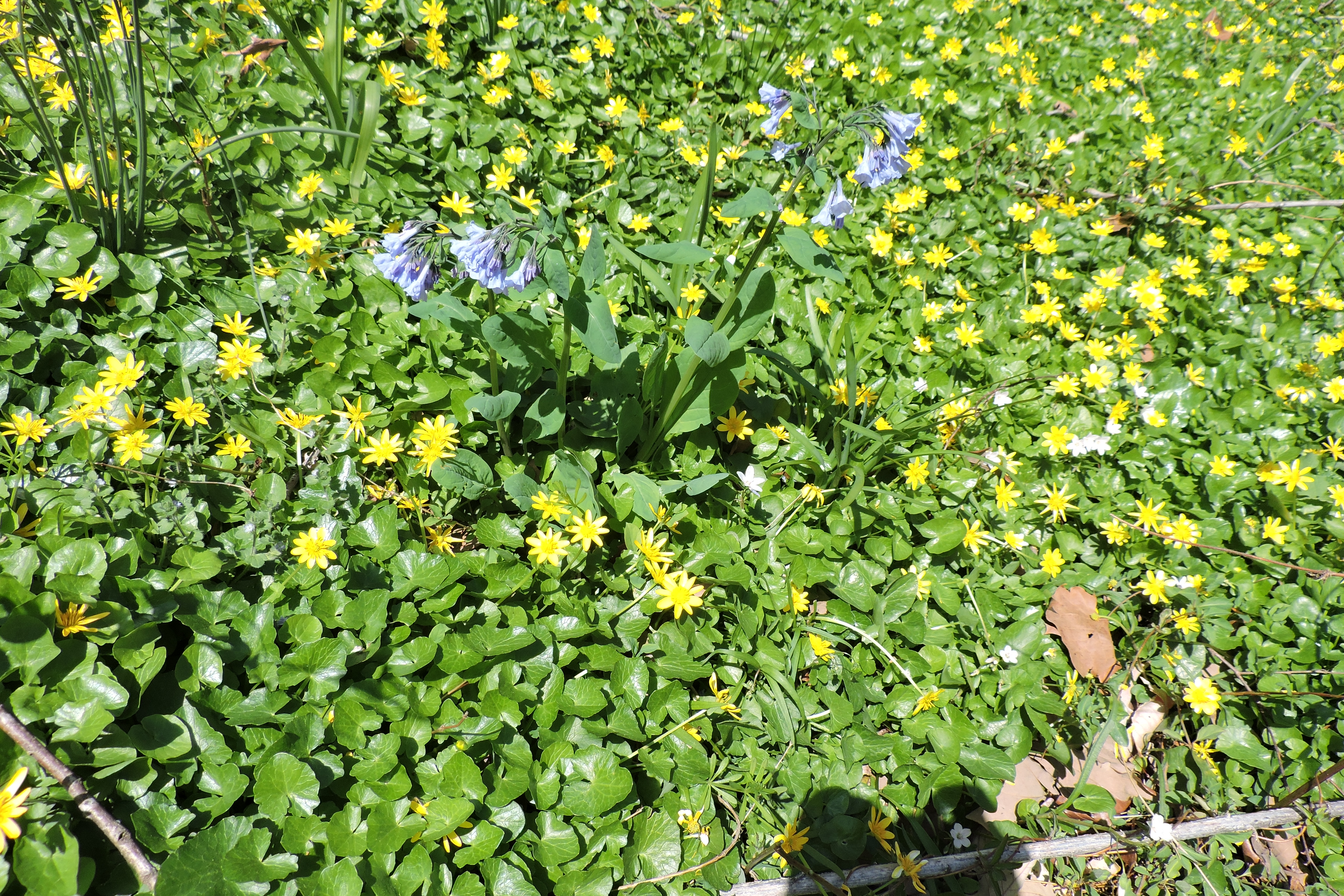
According to ethnobotanist Daniel Moerman, there were a few medicinal uses: The Cherokee used it for treating whooping cough and tuberculosis. The Iroquois used it as an antidote for poisons and to treat venereal disease. The name of "lungwort" suggests its use a lung treatment that was applied to several members of the Genus. Another of its common names suggests its use a food plant: Oysterleaf, although I do not think they taste like that, likely it is one of the other species in the genus that gives it the name. The flowers are said to also be edible. Bluebells can be outcompeted by invasives such as lesser celandine.

Virginia Bluebells can be outcompeted by invasives such as lesser celandine.

In my experience, the primary pollinator seem to be bumblebee queens (the stamen and pistil are too far apart for self-fertilization) and other long-tongued bees, although others claim that butterflies and sphinx moths are the primary. I have seen both tiger and zebra swallowtails nectaring at them. However, more and more, I see the introduced Hairy Footed Flower Bee Anthophora plumipes using bluebell flowers each year. Hummingbirds have also been noted as using them. 

Bluebells emerging.

Doug Tallamy lists 3 Lepidoptera (butterfly/moth species) as using it as a host plant for their caterpillars. By hanging downwards, the plant likely has evolved to protect its nectar from rain washing it away and also loses the petals rather quickly after pollination, increasing the chances that pollinators visit new, unpollinated flowers and not waste time with fertilized blooms. In cultivation, it is generally interplanted with later emerging plants such as ferns that will fill in once the leaves die back. It also is often planted at the top of sloping areas when possible where it will generally reseed itself along the way down and form clumps. They can form large colonies both in the wild and in cultivation. The flowers are bell-like with 5 petals fused into a tube hanging downwards. The plants emerge a purple leaf color before turning to green, a common trait in the Borage family. This plant gained the Royal Horticultural Society's Award of Garden Merit.  A beautiful wildflower, people should go look for them during the first or second week of April (usually) to enjoy them at their peak.

A Virginia Bluebell patch.


Wednesday, March 23, 2022

Yellow Trout Lily


     So here’s a little bit on a common spring wildflower, the Yellow Trout Lily Erithronium americanum. There are 2 other local species: White Trout Lily E. albidum, is rarer, washes down from the mountains to find niches along the rivers and has less mottled, grayer leaves usually; and the other is Dimpled Trout Lily, E. umbilicatum, is also more mountainous and prefers more acidic, infertile soils. This plant goes by a variety of different names: American Trout Lily, Dogtooth Violet, Fawn Ears, Fawn Lily, Adder’s Tongue, Yellow Troutlily, Yellow Trout-Lily, Yellow Lily, Yellow Bells, Yellow Snowdrops, Amberbells, Yellow Bastard Lily, Rattlesnake Violet, Rattlesnake Tooth, Yellow Snakeleaf, Lamb’s Tongue, Snake Root, Star-striker, and Scrofula Root to name a few. The variety of names is due to several reasons. See if you can figure out which ones listed above are due to the fish-like mottling of the leaves (along with its appearance when the fishing for trout was said to be the best)? How about the snake-like mottling of the leaves or the appearance of a snake-like tongue when it blooms between its 2 leaves? Others think the pattern is more fawn-like, thus some of those names. How about the supposed dog-like shape of the roots (corms), at least in Old World members of the genus? Since only those plants with 2 leaves bloom, you get the comparison to ears. The last name hints at its use to treat a skin condition. They are true lilies and not violets though despite some common names. The Genus name Erithronium refers to the red color of some of the European species. Naturalist John Burroughs is said to be the first to use the names Trout-lily and Fawn-lily. All in all, quite a few names it can go by. 

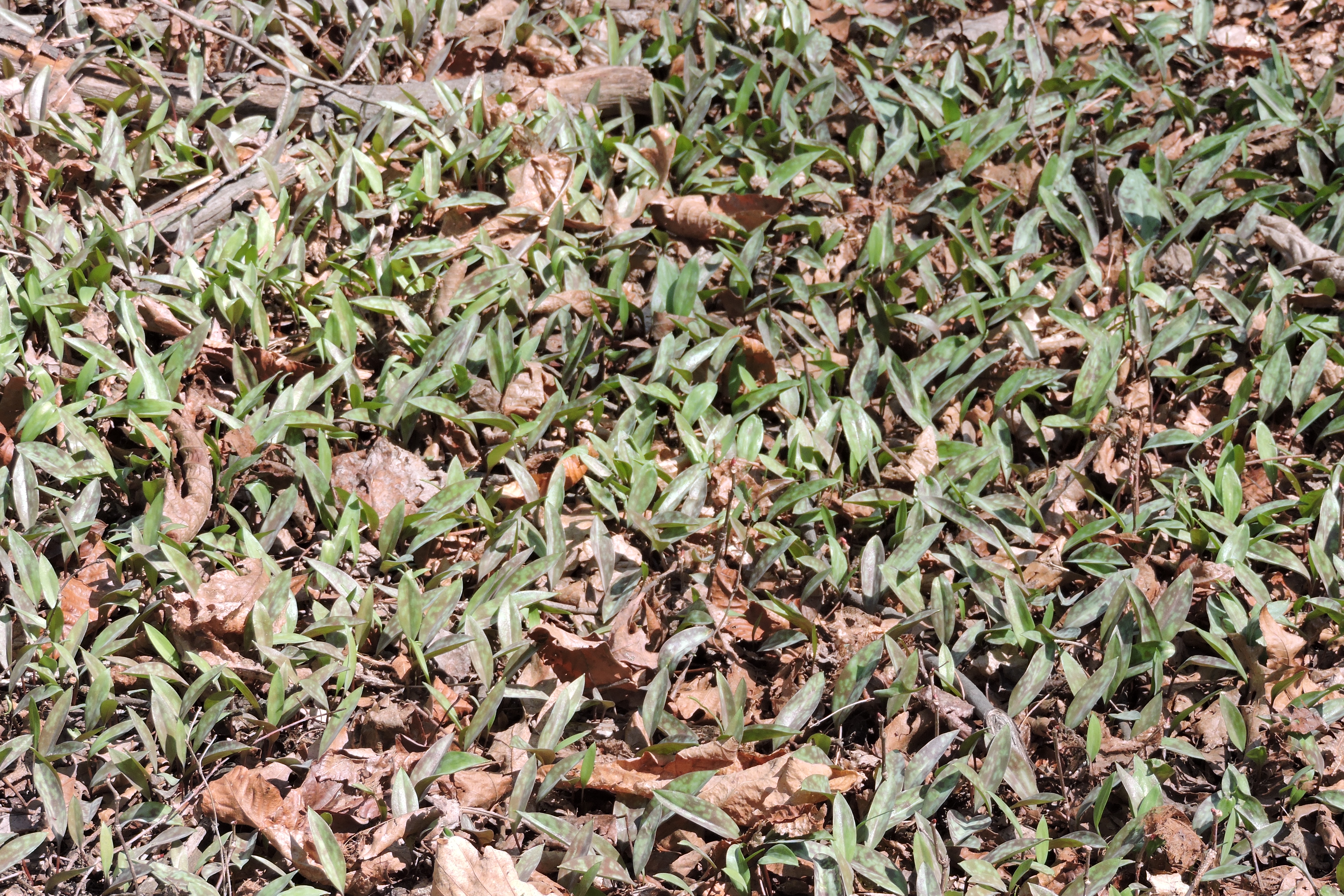
A carpet of Yellow Trout Lilies help control erosion along a riverbank.

     Although they can be quite abundant and form an ephemeral groundcover, very few plants produce flowers, some say about 1%. Some say the secret supposedly lies not only in how healthy and old the plant is but also that it must make contact with a hard surface like a rock. Some can therefore go very deep (going deeper each year up to a foot down) and few in a colony actually flower. It also is believed that it takes plants up to 8 years to store up enough energy to bloom. It spreads quickly though asexually underground using "droppers", a tubular fleshy stem growing from its parent bulb (corm). The anthers (the part of the flower that produces pollen) can range from yellow to brick red. People are studying why there's such a variation in these colors. Like many flowers, they close up when it gets dark and point downwards anyways to protect the nectar and pollen stores. It is a spring ephemeral, the leaves and flowers dying back as the trees leaf out and it can't get as much sunlight. Some colonies are said to have been dated to 300 years old, so again age and health is more likely why only certain ones bloom. The sometimes vast groundcover of single leaves are said to be good at holding back soil and controlling soil erosion. They prefer to grow in fertile wooded flood plains. 

A close-up of a Yellow Trout Lily showing the variation in the anther colors.

  The flowers have 6 backward pointing recurved tepals, a combination of petals and sepals that protect the buds. Bumblebees and the Trout-lily Mining bee Andrena erythronis (a species which prefers this plant for its pollen) are the main pollinators, but even then only 10% of pollinated plants produce seeds. For when it actually does produce seeds in a seed capsule, this plant relies on ants to help disperse it. Like about a third of our spring wildflowers, this is a myrmecochorous plant. It grows an elaiosome on its seed coat which certain species of ants find delectable. They take the treat and discard the seed, often in a rich and protected area where it will have a better chance of growing. Few other wildlife feed on it, though deer sometimes do. Some think the small size and mottled leaves help to hide them from herbivores on the forest floor.

Yellow Trout Lilies in bloom.

     As for ethnobotany, the Genus had lots of uses besides treating the skin for scrofula. Country lore says a tea could be made to rid yourself of hiccups. It was often used in North America by herbalists to induce vomiting and has been used in many types of poultices to treat ulcers and tumors. A tea was made by some tribes for stomach ailments and some roots were eaten as food (the Japanese species is said to be used quite a bit in food dishes). Ethnobotanist Daniel Moerman adds that the Cherokee used the root as a fever reducer and for fits of feinting, while the crushed leaves were used to treat wounds. They would also use it ritually, supposedly chewing it and then spitting it into the water to help them catch fish. Moerman also relates that various Iroquois tribes used the roots as a contraceptive in addition to its use as a skin treatment. The Winnebagos ate the corms (roots) after boiling. Old world species were supposedly used by Roman soldiers for sore feet. 

     Truly there’s more to this wildflower than meets the eye, no matter which name you choose to call it. So keep an eye out for it this spring now that you know a bit more about this wild neighbor who carpets our forests but only hangs around in the spring. 

White Trout Lily for comparison.


Wednesday, February 10, 2021

Periodical Cicadas


     They're coming! And in a BIG way! Billions of periodical cicadas will be emerging from mid April to the beginning of June after spending 17 years underground! These are different from the many species of annual cicadas (sometimes also called dog-day or harvestflies) which grace us with their songs each summer. Though each individual annual cicada lives 2-5 years underground before emerging, they're life cycles are staggered so we get some each year. Most annuals emerge after the last of the periodicals have finished reproducing. 
     Periodical cicadas emerge on prime numbered years, either 13 or 17. The 13 year ones are restricted to the South. There are a couple of theories why this is. One has to do with the ice ages during the Pleistocene Epoch 1.8 million years ago. Summers then were believed to be cyclical, with warmer summers each 13 or 17 years. While underground the temperatures were regulated, the adults emerged on these warmer years. This was a good adaptation as no predators could evolve to take advantage of them emerging so far apart. By all of them emerging in synchronization over a short time period, when ground temperatures reach 64 degrees Fahrenheit in a sustained pattern, usually after a rain, they overwhelm the predators that remain. Through what is called predator satiation, where animals who would eat them are flooded with so many cicadas that they can consume only a small amount, reducing the probability of an individual being eaten, many survive to lay eggs. 
     The cicadas that emerge together in the same year are collectively called a "Brood" which are labeled with Roman numerals. There were at one time 17 broods of 17-year cicadas in North America (30 overall, with thirteen 13-year ones), but now some are now extinct, and only15 survive. Take for example Brood XI which was last seen in Connecticut in 1954. The ones emerging in the DMV and other parts are parts of Brood X, the Great Eastern Brood. This is one of the larger and most widespread of them. For the first time since 2004, periodical cicadas will emerge in parts of Delaware, Georgia, Illinois, Indiana, Kentucky, Maryland, Michigan, North Carolina, New Jersey, New York (though almost extinct (extirpated) here), Ohio, Pennsylvania, Tennessee, Virginia, West Virginia, and Washington, DC. 
     While there are 3,000 species of cicadas (Latin for "tree cricket"), periodical cicadas are a rarity, with only eastern North America having them. This is a natural phenomenon where cicadas form huge choruses by species. For while they may seem the same, there are actually three species that emerge together to then attract their specific females. Each male chorus (for only the males call) has its own species specific songs to attract their mates and they group together for best effect. They last for 5-6 weeks as adults. You will start to notice the burrows as they emerge, or occasionally chimneys or mud turrets in wetter areas, that they form when digging out and then the empty molts of old skins from the emerging nymphs. The nymphs usually have shed 5 times before the final molt to an adult cicada. Nymphs ready to emerge have black spots behind their eyes, but you'll see many nymphs prior to their emergence under logs or flagstones. They will start to burrow sideways when they can't go up anymore and you'll see these the most should you lift the logs and flagstones. Most periodical cicadas have red eyes, but some also have white or grey eyes. 

Periodical burrows and a molt

 
    Brood X includes these three species, which are not always easy to tell apart. The Pharaoh cicadas, Magicicada septendecim, are the largest and the ones that can be found the furthest north of all the periodical cicadas. They are characterized by their broad orange stripes on their abdomen, the patch of orange between their eyes and wing, and of course their species specific song that they all have. The Dwarf cicada, Magicicada cassini, or Cassini's periodical cicada, is smaller, has no orange between the eye and wing, and usually an all black abdomen. The Decula cicada, Magicicada septendecula, is similar in size to the dwarf Cassini, also lacks an orange patch between the eye and wing, and has some orange on its abdomen. The last two are easily confused. They of course have species specific calls and only males call. While the 13 year periodical cicadas are often treated as different species, many now think they're variations of these three species that come out in their own broods of 13 years. 

A periodical cicada sheds its skin for the last time.

     Periodical cicadas, no matter which species, are often called locusts. Actual locust are grasshoppers, so why did they call cicadas locust? This goes back to the first time that a brood was seen by European settlers. In 1633, in the Plymouth colony in Massachusetts, a large emergence of periodical cicadas was reported. This was shortly followed by what they called a "pestilent fever" that raged through the colony and the Indian neighbors. This was close enough to the biblical plagues that included locusts in huge numbers to ensure that name for them. It was a new experience for the colonists and the only thing they could compare it was the locust plagues of the bible. 
     And though the biblical proportions of the cicadas is still hard to believe, and though they pale in comparison to what they used to be, the billions that will arrive will be of epic proportions. Cicadas are known to be among the loudest of insects. Choruses of males singing can reach from 100-120 decibels. This is enough to affect many people with sensitive hearing. This as loud as a rock concert, but will last for many, many days. Interestingly enough, the sound of leaf blowers, power tools, and lawn mowers may attract them. Such chores are best left to early morning or late after noon to avoid any such confusion. 
      The females twitch their wings in response to the males songs when they accept a male to mate with. Once they've mated, the females search for places to lay their eggs. While adult cicadas don't really feed very much, except for some harmless sucking of some plant sap, the egg laying is what people worry about. For the 3-4 week adult life span, mated female cicadas use their ovipositors to slice into pencil-sized twigs to lay their eggs. They lay 24-48 eggs into the slits they carve out until they reach the 600 more so eggs they're allotted. 

Flagging damage by cicadas inserting eggs into stems.

     The egg laying inside these slender twigs causes many to die off. They often wilt and hang down, while others may break off. The wilted and hanging branches are referred to as flagging. Cicadas are picky as to which tree (they don't disturb plants or ferns) they choose to insert their eggs in. They are usually 6 feet or more tall, mostly at the edge of mature woods, where's there some sun, and usually have pencil-sized stems to oviposit in. They tend to avoid lawn areas with small shrubs unless they're near mature woods. For those people who were around the last time cicadas emerged, they normally use the same places to try and lay eggs again. They don't like to use any evergreens, sumacs, pawpaws, many viburnums, euonymus, or Osage orange. Studies have shown that healthy trees don't show long term ill affects, even in orchards which have do not show any decrease in fruit yield. Think of it as natural pruning that has been going on for millennia. If you do want to be cautious, leave your tree planting until the fall. Or protect your trees with 1.0cm netting (but beware that this may trap birds and snakes), but make sure they don't get branches poking through, place only after egg laying has started (which is at the end of May early June around here), and remove then when the egg laying is done. Leaving it on too long will affect the tree itself through distortion of growth patterns and can lead to increase in diseases. It can also affect pollination efforts by other insects. One thing that did Not help was the use of pesticides. Studies have shown that this did not make a difference in egg laying. The young nymphs hatch out after 6-10 weeks and burrow underground to feed on tree roots for 17 years.
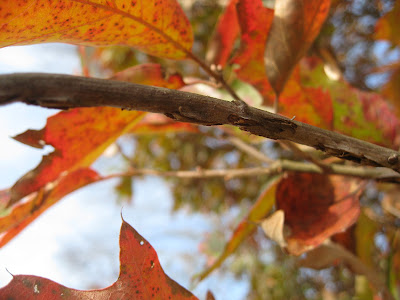
Evidence of egg slits left by cicada ovipositor.

     Now many animals feast on the cicadas, including things you don't normally think of eating them such as squirrels, chipmunks, turkeys, and even copperheads. Many animals, especially birds, will benefit and rear more young due to the extra food supply. Dogs and cats will also feed on them, and this where you may want to be cautious. Cicadas are edible (more on that in a second), but eating too many of the hard shells may cause digestive issues in pets. They do make good bait as some people have learned. I caught a huge carp on one that had decided to surface feed.

A house sparrow feeds on a periodical cicada

     So I did mention they were edible, which includes by people? The native American tribes would consume them when they were available. They've been called the "shrimp of the land" and that is true. They are both arthropods and can make good meals. People every year start to practice entomophagy (eating of insects) when they appear. Don't be surprised to see some of the local restaurants including them on their menus. It's not just countless wildlife species who relish them.

A freshly emerged, or teneral, cicada, still white and soft.

      
     Cicadas are gluten free, low in fat, low carb, rich in protein (the same pound for pound as beef). They've been grilled, skewered, steamed, barbecued, blanched, boiled, blanched, and used in cocktails. My old boss would fill the empty skins with Cheez Whiz and serve them as appetizers. But there are a few things you want to know if trying them (I know I will again!). First of all, they are best when their teneral, meaning freshly molted adults. Get them while their white and soft, before the chitin on their shells have hardened, you don't need all that crunch. Collect them from places that have not been exposed to pesticides and herbicides. As they come up from the ground at night and in the early morning to climb anything they can molt on, that's the best time to get them. Pull off the legs and wings as well. With a bit of Old Bay, they really do taste like seafood. You can see me eat one here: (15) Capital Naturalist: Eating Cicadas - YouTube

The author tastes one yet again...

     Or you can eat them raw, which is likely the least desirable way to eat them:           
             https://www.youtube.com/watch?v=G6VjpqpzHVk&t=2s 
But care should be taken when trying them. First of to be aware of shellfish allergies. Secondly, some studies have shown they do accumulate mercury (again if you're just trying one, not  big deal). But also, be aware that this is a limited resource and we do want to let them reproduce and continue this natural phenomenon. 
     Periodical cicadas emerge and mate well before cicada killers emerge to paralyze the annual green ones to feed their young. More on cicada killers in this blog I put together: Capital Naturalist by Alonso Abugattas: Cicada Killers or Cicada Hawks.  One thing that periodical cicadas can't elude is the Massospora fungi that infects them. This fungus fills their abdomens and destroys their ability to reproduce. Sometimes the entire abdomen falls off. 
     So some of you may remember seeing some earlier than the 17 years. This pre-emergence happens quite a bit. These stragglers, as they're called, usually come especially come out 4 years earlier. This has led to the theory that these actually may be the 13 year ones that some classify as different species. For more on this, check out this blog I did on them: Capital Naturalist by Alonso Abugattas: Periodical Cicadas Early Emergence
     So enjoy this natural phenomenon while you can. These "locust" don't spread disease or eat our crops. They can provide benefits such as aerating the soil or providing food for countless creatures. The next time we can hear and see this unique event won't be until 2038.


Thursday, November 12, 2020

Eastern Coyote


     Our Eastern Coyote (Canis latrans) is a recent arrival with an interesting story. It was first noticed around 1930 or so spreading East near the Great Lakes, as Western Coyotes wandered over and took over the areas vacated by most gray wolves. They mixed with Algonquian Wolves and continued to travel, mixing along the way with dogs as well. What resulted was a mix of about 60% Western Coyote, 30% Algonquian Wolf, and the remainder dog, though these averages can vary. They are now found in every county in the mid-Atlantic. 
     The Eastern Coyote is bigger than those in the West, about the size of a border collie or even German Shepherd, often between 45 to 55lbs, though occasionally bigger. The males are usually larger than the females. They are not only larger, but often tend to be more quiet than their western cousins, not howling as much, and often in much smaller groups. They're color can be variable as well, though they're often some shade of tan, with erect ears, bushy downward-pointing tail with a dark tip. Most have white chins as well.
     Coyotes are opportunistic feeders, including vegetables and fruits in their diet along with meat. They are great scavengers, often eating roadkill deer. They rarely take down adult deer, unless the deer is injured or otherwise ill. They will however see any small pets as food, particularly outdoor cats, when they find them wandering off in the woods. This is just one more good reason among so many to not let cats out. 
     Coyotes are remarkably shy and avoid people any way they can. Most are rarely seen, and certainly are no danger to people, unless they are very sick. If you do think that the animal is sick, you should call Animal Control. Coyotes will usually run away at the first site of any people. Now if you do encounter a coyote, that is obviously not sick, clapping of hands, yelling, throwing things, shaking a can with pennies, are all ways to get the animal to run away. You should never feed coyotes, or leave food out for other animals such as cats. That can lead to them becoming accustomed to people, which can be bad for the coyote and people. Here is an example of a coyote that has become accustomed to people: 


.
     People have been living near coyotes for a long time, though most have no idea that coyotes are around them due to the coyotes' shy nature. If you do see a coyote, consider yourself very lucky. Most have no idea that they are around at all, especially since they are mostly active at night. See below an example of one investigating a fox den and the lights from a game camera, all in one of our urban parks: 

Thursday, May 7, 2020

Asian Giant Hornets

Asian Giant Hornet (Vespa mandarina)
Photo by: [q13fox.com/2019/12/22/invasive-asian-giant-hornet-found-in-washington-state/amp/]
 
     There's been a lot of hype lately concerning the Asian Giant Hornet (Vespa mandarina) after a New York Times article revealed that some had been found in Washington state a year ago. They even gave them an equally sensational name of "murder hornets" despite no entomologist ever having called them this. So I think it's time to set the record straight on these large wasps and the couple of things locally you really are much more likely to get them confused with.
     So let's be clear that this discovery was last year, first in September in Nanaimo in Vancouver in British Columbia, Canada, They quickly destroyed the nest and set up traps to see if any other ones were around. It was in December of last year that they found dead Asian Giant Hornet about 50 miles away in Washington state. Despite it's proximity, some tests determined that it was not from the same underground colony as the others. Since then, there have not been any more of these hornets seen live or dead in the USA, just the ones from 2800 miles away the previous year.
     Now if these Asian Giant Hornets, the largest of all hornets, are found to have been established colonies, that would be bad for our European honeybees that did not evolve with them and have no defenses such as the Japanese honeybees do. But this unlikely to happen with controls in place and it would be near impossible for that to happen here in the DC area.
     So all the hype is just that, just hype. I've already been getting people sending me pictures to see if they have found one. They have of course all been negative, just local species that people have people have made the villains. Let's recall a few natural history facts relating to Asian Giant Hornets. Much like other hornets, they only produce queens that can start a new colony at the end of the year when their original nests fall apart. Each individual worker hornet cannot produce any new nests. Only those at the end of the year that have been fertilized by male nonstinging hornets can produce eggs. Please recall that no male bees, hornets, or yellowjackets can sting, as the stinger is a modified ovipositor (egg layer). So males, as they don't lay eggs, can't sting. The odds of a fertilized queen finding their way over here in the DC area, knowing that a very small population at best was found 2800 miles away, is extremely small. They also prefer deep woods to establish their underground nests, which again is not as likely to happen in our DC urbanized area.
     Let's also look at this sensationalized name of "murder hornets". Now despite the claims, they are actually have less toxic venom than some of our local yellowjacket species. Now they are bigger so likely may inject more, but they are not looking to sting people. Much like our other social wasps, they will defend their nests, when they're threatened, but overall do not look for people or attack them in more numbers than any of our local wasps. If someone does have an allergy to them, then that could be a problem, and no tests have shown they are any more likely to have people allergic to them than our own honeybees. In fact, more people die of allergic reactions to honeybees in the US than they do from Asian Giant Hornets worldwide each year. And this is still less than those that die from getting hit by lightning each year as well.
     Now complete disclosure, I am (or perhaps was) allergic to yellowjacket stings. This did not mean I was allergic to other stinging insects such as paper wasps or honeybees.When you have an allergic reaction, it is often pretty specific. The venom of each is different, so just because someone is allergic to bees, does not mean that they are also allergic to hornets or yellowjackets, or vice versa. For me, as I'm outdoors all the time, I had been stung too many times, including when I was with kids who batted at yellowjackets for which I got stung getting them out of the way. I got stung once too many times and ended up in the hospital. I've since gone through therapy getting injections from yellowjackets so that I'm supposedly resistant again to them. Funny that since I was aware of this, I've not gotten stung in many years. I'm gotten almost a 6th sense about yellowjackets, even though my job often requires me to investigate these stinging reports.
     Now again, despite all the hype, you are very unlikely to find any anywhere near the DC area, we will show what they look like compared to the two other locally found large species in our area. Now of course many people will look at size as the first thing they will notice. And it would be important. Maxing out at 2.2 inches, Asian Giant Hornet queens are the largest of the hornets. The workers which you would most likely see if any were any in this area are much smaller at 1.5inches. Believe it or not, people actually eat their larvae in some places.
 
A comparison of the 3 largest stinging insects in our area. These are all workers, except for the Cicada Killer which is a female. Notice the eye placement of the Asian Giant Hornet well in front of the head.
Photo from Franklin Master Gardeners

     While size maybe the first thing you notice, we have two others of similar or greater sizes (recall a Cicada Killer is not a hornet and the females who prey on cicadas are larger than other workers). For Asian Giant Hornets, their eyes are set far forward on their yellowish/orange heads. They tend to have distinctive fairly similar stripes across their abdomen. And once again, a reminder that No Asian Giant Hornets have been found in the DC area, or outside of last year's discovery of a dead one in Washington state.
     The creature most likely to be confused with the Asian Giant Hornet around here is the European Hornet, a rather large relative with a dark head and irregular stripes across its abdomen. These were originally introduced into the USA over a 150 years ago, and have in that time extended their range to the eastern third of the United States. This does go to show, that with similar life cycle to Asian Giant Hornets, it would indeed take a long time for them to really expand their range. Right now the extremely large queen European Hornets have overwintered and are looking for places to build their nests. These are the most easily confused to the Asian Giant Hornets. They usually choose an opening in a tree, but some have occupied sides of buildings.
    
A European Hornet worker (Vespa crabro) showing its size difference with a Yellowjacket flying over top. They take all sorts of other insects as food for their young, particularly preferring cicadas leading many to confuse them with Cicada Killers.

     These nonnatives have never endeared themselves to people. Workers are large at about 1.4inches long. They spend most of the summer hunting other insects to feed their young. This includes taking of large butterflies like swallowtails and Monarchs, along with large bees and wasps. I've seen them wait for the pollinator to use a flower and then trap their prey against the bloom. I've also seen them take down full grown mantids.
     They also cause damage to trees. They will tear off small pieces of bark to use in making their nests. They seem to really prefer lilacs, but also take advantage of sapsucker wells to start striping the bark in squares. They will often eventually lead to stripping so much bark they girdle the tree so it dies.

A tree girdled by hornets.

    These are also one of the few wasps and hornets that are attracted to light. This does confuse and puts them in a bad mood, should they come to your porch lights.


An injured European Hornet that has been attracted to light and then caused damage to itself against the light fixture.

    In the Fall, after much of their raising of their young has concluded, they are often attracted to fruit. This does make these nonnatives a pest of orchards.

An apple tree feeding European Hornets.

     The other large creature (they can get to just over 2inches) often confused for Asian Giant Hornets are Cicada Killers (Sphecius speciosus) or Cicada Hawks. These are large solitary wasps that build individual holes in the ground they then fill with cicadas for their young to feed on. Though on average larger than the other species talked about here, they are actually quite docile and difficult to get angered enough to sting. People often mow grass right along side them with no fear of retaliation. They're stings are also said to be very mild as well, contrary to the reputation of the previous wasps discussed. As these are solitary, they prefer to fly away than to defend their nests, for if they die, no one will raise their young. So despite their large and ominous appearance (the males who can't sting are often flying low over burrows and can be intimidating), females only go after cicadas and are harmless to other creatures. These tend to come out in mid summer and look for sandy areas to build their holes. You can read more about them here in this blog: https://capitalnaturalist.blogspot.com/2016/07/cicada-killers-or-cicada-hawks.html

A female Cicada Killer makes off with a cicada to provision her burrow for her young.

     There are few others that are large enough to be mistaken for Asian Giant Hornets. One is another hornet, the Bald-faced Hornets that are large and have their nests in trees. More on the in this blog: https://capitalnaturalist.blogspot.com/2016/09/bald-faced-hornets.html

A Bald-faced Hornet (Dolichovespula maculate )
     A short video of several wasps taking advantage of an injured tree with sap is here: https://www.youtube.com/watch?v=FaUB2v9H4Go&t=2s
     Most people recognize fuzzy bumblebees so as to not confuse them with others. A few though get worried due to the size of carpenter bees, as I've been sent some pictures to ID them. While they may also seem to be intimidating, they are pretty much harmless. More here on them and bumblebees here: https://capitalnaturalist.blogspot.com/2014/10/carpenter-bees.html .
     The bottom line is that though it's always good to be aware of invasives, the scare tactics out there so far is just hype. Calling them "murder hornets" and scaring people on what really is an extremely low chance of anything happening around here is poor reporting at the very least. The damage they've done as people just start destroying other beneficial pollinators has already taken place. While destroying a few nonnatives European Hornets is not a bad thing, the others such as cicada killers and other pollinators that will also suffer is sad to see. Folks, please don't get scared by these poor reports that are going on out there. The chances of seeing any Asian Giant Hornets, "murder hornets", when they've only been seen a year ago 2800 miles away is extremely low. So its good to be aware, but irrational to let this scare you that every big bug you see is a danger to you.