Friday, April 29, 2016

Black Locust


     Black Locust (Robinia pseudoacacia) is a medium sized tree that you may notice in bloom right about now. Whether due to its profusion of white flowers or their sweet perfume, this tree stands out at this time of year. Sometimes also called Yellow Locust or False Acacia, it rarely gets taller than 80'. It is a short lived (generally under 100 years) member of the Pea Family (Fabaceae). Its Genus name was given in honor of a father and son team, Vespasian Robin and his father Jean, who served as botanists in French King Henry IV's court. Indeed, the oldest living tree in Paris is said to have been planted by Jean Robin in 1601 and is an ancient Black Locust. The Robins helped make locust popular throughout Europe where it was planted extensively. Here in North America, it has now been introduced into every state.
     A pioneer tree, locust grow fast and can take very poor soil conditions. Because it is a legume, enriching the soil due to the nitrogen fixing bacteria that dwell within their roots, it is often planted in strip mined locations to reclaim the land and to prevent erosion. It can bloom in 6-12 years after planting.


Black Locust have compound leaves and paired thorns. Because this is a young sapling, it has larger leaves and thorns than a mature tree.

     This tree has deciduous, compound leaves and paired thorns. The leaves are interesting in that they fold up and droop at night and during very cloudy weather. The flowers consist of hanging racemes of very fragrant, white flowers. These are extremely attractive to some bees. Black locust is considered a major honey plant, and honey made from its flowers is sometimes sold as "acacia honey." The flowers themselves are edible and sweet. In fact, I find them quite enjoyable myself, though I've learned to make sure ants are not sharing my enjoyment of them. In Romania, perfumed jam is supposedly made out of the blooms from introduced trees. 


Black Locust have fragrant, white flowers that hang in racemes, often with yellow centers.

     Pollinated flowers result in 4-14 seeds contained in bean-like pods. Although a pioneer species, this tree does not compete well with other plants. It is one of the trees most affected by the allelopathic chemicals that goldenrods produce and thus are not often found germinating in meadows near where the goldenrods are dominant. Most new growth results from root suckering, with new trees popping up away from the parent tree. These are all clones of the parent plant. Locust do not tolerate shade, so give way to other longer lived trees later on, having in some cases enriched the soil before their demise.


Black Locust seed pod

     Various native tribes made use of Black Locust. The Chickasaw used the roots to treat headaches. The Menominee flavored bitter medicines using locust bark. The Cherokee made the most use of it however. They chewed on it for toothaches and to induce vomiting. They made a bark tea from it and created both bows and blow gun darts from it as well. They found the wood useful for fences and as pegs in log cabins. They even gave it as a tonic to their cows.
     During the Civil War, Confederate Dr. Francis Porcher, charged with finding alternatives for goods no longer available due to Union blockades, listed several uses for Black Locust. He suggested that an antispasmodic syrup could be made from the blooms. He related that the flowers could also cause drowsiness and vomiting in infants, but that they could be fried and eaten. The inner bark could be used to make cordage and other rope. Porcher considered the wood to not only be useful for fence posts, but as wood tree nails in ship building.
     The durability of the wood means that Black Locust has often been used for fence posts and rails. The lumber is very rot resistant even when in contact with wet soil. Abraham Lincoln is said to have split many a locust log. It also burns very hot, but is prone to shooting coals out due to imperfections in the wood.


Locust Borer Beetles are wasp mimics who feed on goldenrod flowers as adults, but bore inside Black Locust as larvae.

     Many of these imperfections in the wood are due to the work of outside organisms, the most prominent of which are the Long Horned Locust Borer Beetles (Megacyllene robiniae) which even bear the treesname as part of theirs. These drill through the wood as grubs, weakening the wood and causing splitting and dropping of limbs. Interestingly, these beetles are Yellow-jacket Wasp mimics who love to feed on pollen as adults. Ironically, their favorite flowers are those from goldenrods, the very plant who exudes chemicals that inhibit the growth of the locust trees. The galleries the grubs make open up the tree to the growth of fungi. The most apparent of these is a bracket fungus, Phellinus rimosus, which are easy to find on older trees. This, along with their intolerance of shade, may limit their age in North America, but they can live for a very longtime when freed from these limitations. The oldest tree in Paris I mentioned earlier is a good example, since the locust borers I believe are not found in France.  


Locust Bracket Fungus is often found on older trees and can result in heart rot in the trunk. 

      Many other creatures make use of Black Locust. In fact, over 72 caterpillar species feed on it. This includes the larvae of a common butterfly, the Silver Spotted-skipper (Epargyreus clarus) which folds the leaves over itself to make its shelter. Although not a favorite, numerous animals feed on the seeds and browse the foliage as well.  


Silver-spotted Skipper caterpillars often fold leaves on the legume plants they feed on, using multiple leaves when they get to big to just fold one over themselves.
Silver-spotted Skipper caterpillars will try and scare you off with their fake eyes if their shelter is disturbed. 

     As a child, I had two large Black Locust growing in my yard. I played under their shade, ate the sweet flowers, and occasionally cursed them when I stepped barefoot onto a fallen thorn. I even fell and was knocked unconscious once when I fell from high in its canopy, resulting in an ambulance ride and much concern to my family. So seeing these trees in bloom every year brings back all sorts of memories from my youth, usually made even more vivid since I can't resist but taste the flowers again every year. 
     
Enjoying some Black Locust flower buds again this year...

Tuesday, April 19, 2016

Arlington's Amphibian Resurgence

A male Spring Peeper Treefrog calls from an Arlington pond

     Arlington County, Virginia is very urbanized. Due to loss of wetlands (including vernal pools) and heavy development, half the frog and toad species that used to live in Arlington are now gone. The remaining species are often in small, isolated populations, in only a handful of locations. Frogs and toads are excellent bio-indicators if environmental health. Since they consume plant material when young and then switch to a predatory diet, they can build up toxins in both diets. Since they can also absorb chemicals and pollutants through their skins in all stages of life, they are also very sensitive to changes in the environment. So loss of frogs and toads can point to an unhealthy environment and their declines can serve as a warning about the state of the habitat.
     Conversely, their presence can often be a clue to healthy, clean water and their return perhaps signaling improving conditions. This is why we are happy that the frog and toad populations have been expanding in our Arlington parks. Take for example the current status of American toads, which during our surveys from 2005 to 2008 were found to be restricted to one wild location. We now have them in 6 additional places. Similar successes in expansion of range have happened for our Bulllfrog, Green Frog, and Spring Peeper Treefrog populations.

American Toads calling. 
   
     In addition to having cleaner water and preserving our wetlands, the control and management of invasive plant species has allowed the habitats to support more insect food. Native plants that have also been making comebacks support more insect prey than the exotic invasive plants (and these insects then feed so many more animals such as most of our bird and all our bat species).
     Some of our frogs needed a bit more help in getting established. Such was the case for our Wood Frogs which are dependent on mostly fish-free vernal ponds and mature woodlands. For the longest time Arlington only had two places where they bred. In time, the population from Long Branch Nature Center eventually made it into Glencarlyn Park on its own. But since these frogs need mature woods and vernal ponds that may not be close to one another, we assisted in establishing new populations.
     Now these efforts have to be carefully considered. First of all you need the right habitat with established woodlands and fish free vernal pools. They need to have enough invertebrate prey to sustain them. We felt we had a couple of locations where we had controlled invasives, had mature forest, and could provide the wetlands they needed to reproduce. During the last year of service from our Americorps volunteers, they helped us create some vernal pools in one of our Natural Resource Conservation Areas. An Eagle Scout project provided similar service in another park that contained another Natural Resources Conservation Area.
     With these things in place, we decided it was worth the effort to try and establish new colonies of Wood Frogs. But another concern was the potential introduction of two new diseases (Chytrid and Ranavirus) which were affecting amphibian populations. Luckily for us, the pond we used for stock was tested for these diseases. It ended up being part of two studies, mostly through the Smithsonian, and eventually came up as being clean.

Wood Frog egg masses in an Arlington pond

     Now we have more breeding populations of these woodland frogs. We've recently tried to create additional vernal pools, in locations where we hope the existing frogs can expand their range. We've also made efforts or plan on creating more ponds on the opposite side of such existing barriers as creeks and roads that make their migrations to the breeding pools very dangerous. Despite such programs as our "Stop the Stomp" volunteers helping to guide them across roads, we want to provide them with pools closer to locations so they need not make these dangerous journeys. As our habitat for these amphibians improve, they do so for many other animals as well. Hopefully Arlington will continue to make strides in providing habitat for the return of many other animals and plants such as these frogs.
     Here's a short video of one of these successful efforts:
                       https://www.youtube.com/watch?v=aaQxe35yuDQ    
   

Friday, April 15, 2016

Flowering Dogwood


     Flowering Dogwood (Cornus florida) is both Virginia's state flower and tree. It serves as the state tree of Missouri and state flower of North Carolina as well. Flowering Dogwoods grow in the understory, rarely over 35' tall, with opposite branching. They are in peak bloom in our area right about now, the actual flowers themselves being quite small, but the "petals" (actually bracts) attracting a lot of attention. If pollinated, they form bright red fruits called drupes. The fruit changes color and matures at the same time that the leaves change color. 

Flowering Dogwood fruit, technically drupes.

      This is something referred to as "fall foliar fruit flagging." The bright fall color "flags" birds down who then are able to find the fruits. This gives the short tree an advantage, standing out and having its drupes eaten and seeds dispersed instead of getting overlooked among the taller forest trees. This is a strategy many fall fruiting shrubs use. The leaves themselves decompose faster than most others, returning their nutrients quickly back into the soil.  Flowering Dogwood also has very distinctive turban-like flower buds in winter, which along with the opposite branching and alligator-like bark, makes identification of this tree fairly easy.

Flowering Dogwood opposite leaves and Fall color.

     The drupes are an important and favored food for birds, being high in fat content. Over 98 species of birds have been documented eating its fruits. Unfortunately, a fungal disease called Dogwood Anthracnose is spread very easily, being picked up by the bird in migration when it stops to eat and then transferred further along the migration route to yet other Flowering Dogwood trees when the bird lands again. This is killing a high proportion of the trees and was likely brought over in the horticultural trade on Asian Kousa Dogwoods which are resistant to the fungus themselves, but can act as carriers and infect the natives.

Flowering Dogwood's turban-like buds in winter.

     Flowering Dogwood has a deep ethnobotanical history. Native American Indian tribes made considerable use of it. The Cherokee, among other tribes, for example chewed the bark for headaches, and used other parts to treat for fever, diarrhea, measles, and intestinal worms. The twigs could be used for toothbrushes of sorts and had a reputation for whitening teeth among not just the indigenous people, but Africans whether slave or free, and throughout the South. During the Civil War when the Confederacy was particular short on supplies, Flowering Dogwood was officially sanctioned by Dr. Francis Porcher in 1863 in their official ethnobotany manual as "one of the most valuable of our indigenous plants." It was used by the South in many of the same ways as by the native peoples, but also as a substitute for Peruvian quinine in treating malaria, as a dye, for stomach issues, for durable hand tools, and was preferred in the manufacture of gun powder. One version of how it received its common name refers to its supposed use in treating dog mange, thus "dogwood." Others say the name is derived from the "dags" or dagger-like skewers when people used them for cooking. "Dagger-wood" eventually turned into Dogwood.
     As far as legends, here's a follow up Blog article:
           http://capitalnaturalist.blogspot.com/2014/05/the-legend-of-flowering-dogwood.html

     Here's a short video on Flowering Dogwood from the Capital Naturalist YouTube Channel:
                     
                       https://www.youtube.com/watch?v=z0fxt-ZYo7w

     As you can see, there is much more to this plant than just it's good looks. It serves as the caterpillar host plant to 112 different butterfly and moth species. Whether in its roles in feeding our wildlife or traditional medicine, this is a tree worthy of being a state symbol.

Wednesday, March 30, 2016

Trailing Arbutus - Plymouth's Mayflower


     Trailing Arbutus (Epigaea repens) is a very uncommon plant of shady hillsides. It is an evergreen, and so requires a place where it will not be smothered by leaves. This usually means a slope along a wooded section where the leaves don't stay, but this also means it is very subject to erosion. It doesn't take much for it to get washed away or trampled. The male and female flowers are also normally on separate plants, so it doesn't set fruit very reliably, the plants sometimes being spread a bit far from each other for the pollinators to find the different ones. Add to the fact that it requires a specific symbiotic mycorrhizal fungi to also be present, and you can see why this plant is getting rare and rarer. 
     This plant goes by various names. The Genus Epigaea means " on the Earth." The scientific epithet repens means "creeping." So what you have is the very descriptive name of the plant who "creeps on the Earth."  That is indeed what this little woody plant does, forming small mats that rarely are taller than 6 inches and forming little ground covers over a very long period of time. Ground Laurel, as it is sometimes called, is an extremely slow grower. 

Trailing Arbutus in its typical habitat, creeping down a wooded hillside.

     Trailing Arbutus is also referred to as Plymouth Mayflower, or sometimes just Mayflower. Since it is one of the first plants to bloom, well before May, the name is actually derived from a legend. It is said that the first bloom the pilgrims trying to settle in Plymouth in 1621 saw was this plant, whom they named after their ship. This member of the Heath family (Ericaceae) is also sometimes called Winter Pink, Mountain Pink, Gravel Plant, or Shadflower (supposedly blooming in time with the influx of migrating shad fish). 
     Although this plant has leathery evergreen leaves, it is best known from its small clusters of 5-petaled white or pink flowers. These often bloom in March through April and are very fragrant. They hold good supplies of nectar, enough to lure bumblebee queens (their primary pollinators) into looking for them even if they are sometimes covered in leaves. If a bumblebee is able to find 2 flowers of different sexes and pollinate them, then a berry-like capsule is formed. The seeds they contain are very attractive to ants who act as the main seed dispersers (a process called myrmecochory, more about that here:   http://capitalnaturalist.blogspot.com/2014/04/myrmecochory-ants-in-our-plants.html )
Two species of caterpillars also feed on the leaves.


     The flowers are said to be edible and quite tasty, but the plant is getting so rare, that to eat them is a shame, and an actual crime in some areas. I've never tried to taste one. But Trailing Arbutus has been used by people for more than just food in the past. The Algonquian Quebec tribes used a leaf infusion to treat kidney ailments. It turns out that the leaves do contain a substance called arbutin that has been used medicinally to treat kidney stones and urinary tract disorders. 
     The Cherokee also made use of the plant, to treat abdominal pain, induce vomiting, treat diarrhea, indigestion, in addition to kidneys. The Haudenosaunee (sometimes called the Iroquois) thought it could be used for labor pains, rheumatism, kidney issues, and indigestion. For the Potawatomi, it was a sacred tribal flower.
     So there's a lot to this little woodland creeper, though it gets harder to find every year. Though sometimes sold commercially, please make sure that it is not collected from the wild. If its is disturbed, the symbiotic fungal relationship is usually broken and the plant soon dies. So please never remove it from the wild. If you are lucky enough to find it, enjoy its beauty and fragrance, it is well deserving of being the floral emblem of Nova Scotia and state flower of Massachusetts, and was the Virginia Native Plant Society 2001 Plant of the Year.


Cut-leaf Toothwort


     Cut-leaf Toothwort (Cardamine concatenata, formerly Dentaria lacinata) is a spring wildflower of rich, deciduous woods. It is in the Brassicaceae, or Mustard Family. This plant rarely grows over a foot tall. It is an ephemeral, producing leaves, flowering, seeding, and then dying back by the time the trees leaf out and sunlight is no longer available.
     Its white flowers have the petals in a cross-shape typical of the "cresses" or mustard family. During cloudy weather and at night, they hang downwards and close, protecting the nectar they hold from rain and the elements. These flowers are pollinated mostly by solitary bees and a few flies.
     The leaves on this species are in a whorl of three that grow around the stem all pretty much on the same level. They are deeply divided, thus giving them the "cut-leaf" portion of their name. This trait also was what gave them their former scientific epithet of lacinata. The position and shape of the leaves differentiates them from a few of the other Toothworts that are occasionally encountered, though none are as common as Cut-leaf in the immediate DC area regardless.

The cut-leaf whorls of leaves of the Toothwort in my yard.

     The name Toothwort comes from the supposed similarity of its bumpy root to a tooth. This once also helped give it its former Genus name of Dentaria. The suffix -wort often signifies an herbal use, and this plant is no exception. The roots' similarity to teeth was taken as a natural symbol for using it to treat tooth problems, something referred to as the Doctrine of Signatures (that a higher power had left a sign on the plant as to what it was to be used for). Toothworts have been used in the past to treat dental issues by various cultures.
     But is has been used for other treatments as well. The Haudenosaunee, whom some call the Iroquois, for instance had numerous uses for it. A poultice of its crushed roots was applied to the head for headaches. It was used to treat colds, wounds, and as an appetite stimulant. It was also used to deal with heart ailments. Interestingly, its current Genus name of Cardamine is derived from a Greek term for a mustard plant that was also used to strengthen the heart.
     The Haudenosaunee were said to rub Toothwort on guns, traps, fishing line, and hooks as a "hunting medicine." Some would carry either the root or plant on their person or in their mouths in the belief it could attract women. It was even thought that this plant could be used to help with divination. Of course it could just be eaten as well.
     It's use by many people as an edible give it other names, such as Pepper-root or Wild Horseradish. The ground roots mixed with vinegar are sometimes used as in a similar manner as horseradish. Indeed, the roots have been eaten raw, cooked or salted for generations. This of course kills the plant however and so should only be done where it is plentiful or grown in a shady garden.
     Toothworts actually are not difficult to grow in rich, shady garden conditions. The roots are easily planted, but hate being disturbed while in bloom. It can also be grown from seed. The seeds though are not always easy to collect, as they hang in pods from pollinated flowers, but split and shoot the seeds a short distance away when they are ripe. It also may take 3-4 years for the plants to store enough energy in their roots to finally flower from the time they sprout from seed.

A Cut-leaf pod and seeds

    Despite its short growing season, Toothworts serve as host plants, caterpillar food, for 6 different species. Locally, both Falcate Orange-tips and West Virginia White butterflies use it. For the West Virginia White butterfly caterpillar, for whom it is the most preferred food almost to the exclusion of all others, this has led to its extirpation in many locations.
     West Virginia White butterflies come out in the early spring and fly in search of Toothworts. They land on plants when they believe they've found them and "drum" or scratch the surface with their front legs, which serve to also "taste" the compounds within the leaf surface. When the butterfly detects mustard oils, it knows to lay its eggs. The problem is with the spread of the inavsive exotic plant Garlic Mustard.

The much taller and more prolific invasive Garlic Mustard

     It grows much more prolifically than Toothworts do, and also secretes chemicals which inhibit the germination of other plants. This chemical warfare by plants is called allelopathy, and is in addition to simply out competing native plants. Slowly Garlic Mustard replaces the natives. For the West Virginia Whites, this is deadly. The caterpillars cannot feed on the similar mustard oils of Garlic Mustard, and so are poisoned and die. As the invasive Garlic Mustard has spread, the butterfly has declined along with its host plant.
     Cut-leaf Toothwort, sometimes also called Crinkleroot (though Slender Toothwort is called this more often) or Crow's Toes, might make its appearance for a short time every spring, but is an important wildlflower. Not only does it serve as a valuable food plant for certain butterflies, a nectar source for native pollinators, but has been valued by people for generations, even if only for its fleeting beauty.

Slender Toothwort, or Crinkleroot, has different shaped leaves (including a basal leaf and only 2 slender leaves along the stem) and is much less common in the DC area.

Wednesday, March 23, 2016

Lesser Celandine - Fig Buttercup


     Lesser Celandine (Ficaria verna, formerly Ranunculus ficaria) is an invasive exotic perennial that covers whole section of moist woods and waterways in spring. It can look quite attractive when it carpets the early spring with its yellow flowers (typical of plants in the Buttercup family). Looks are deceptive however, as this plant is quite aggressive and out competes native plants, particular spring ephemerals.
     Lesser Celandine goes by many names including Fig Buttercup, Figroot, and Pileroot. Its scientific name Ficaria means "fig" in Latin, while its species name verna means "spring." Pileroot is derived from its use in treating hemorrhoids, which can also be called "piles." It is originally from Europe and western Asia, but after its introduction as an ornamental, has spread to many other regions.
     We have an uncommon native plant called Marsh Marigold (Caltha palustris) that can be confused with Lesser Celandine. It is much more common in the mountains, rarely seen around the DC area. It is a taller plant that forms small clumps rather than acting as a ground cover like the Fig Buttercup often does. If in doubt though, just turn a flower over to confirm. Lesser Celandine has sepals (protective petal-like covers that protect the actual petals) which Marsh Marigold flowers lack.

A Marsh Marigold flower to the left and a Lesser Celandine flower to the right showing the sepals that cover the petals when in bud. 

     Although Lesser Celandine has been used medicinally, it is poisonous. It contains a compound called protoanemonin, which many other members of the buttercup family also have. It can cause blisters and rashes when it makes contact with skin. If ingested, it can cause nausea, spasms, and even paralysis. It's has proven to be fatal at times to livestock. This has led to it being declared a noxious weed in some states.
     But it also has been considered edible by others. The toxic compounds are rendered harmless if dried or cooked. This has led to its use as an herbal remedy and even as a vegetable. In Germany, it is sometimes called Skorbutkraut, which translates to "scurvy root" due to a belief it has high concentrations of vitamin C to prevent scurvy. Many believe this is a case of mistaken identity though with another plant that looks like it, Scurvy Grass (Cochlearia officinalis) and which is also used for the same reason, and actually does have high vitamin C concentrations.
     Lesser Celandine is an ephemeral, emerging in late winter and completing its flowering before the trees leaf out and then going dormant until the next season. It gets a jump start against most plants, including other native ephemerals, and eventually crowds them out. Since it goes dormant by summer, the bare patches it leaves often result in erosion. This is also to its advantage as any pieces of its bulbs can take root and spread.

The bulb-like roots of Lesser Celandine

     Disturbing the ground and breaking off pieces thus results in it being dispersed. This makes it extremely difficult to control using any mechanical methods. If you try and dig it out, you not only disturb the soil and make it easier for other invasives to take root, but any piece you miss just becomes a new plant. In reality, using herbicides in a judicious manner and at just the right time is the only practical control for this invasive. This is usually when half the flowers are in bloom. 

A patch of Lesser Celandine covering the ground so thickly that no other plants can grow.

     While it may form large spring displays of flowers, this plant is a nasty invasive. It has spread to 24 states and can completely blanket and smother native plants that provide much better, diverse habitat. It is sad to see how it carpets huge areas of what should be native ephemeral wildflowers.

Lesser Celandine blanketing an area to the exclusion of other plants.

     More on this from my YouTube Channel: https://www.youtube.com/watch?v=S2kynTVBAXA


Tuesday, March 22, 2016

Tent Caterpillars


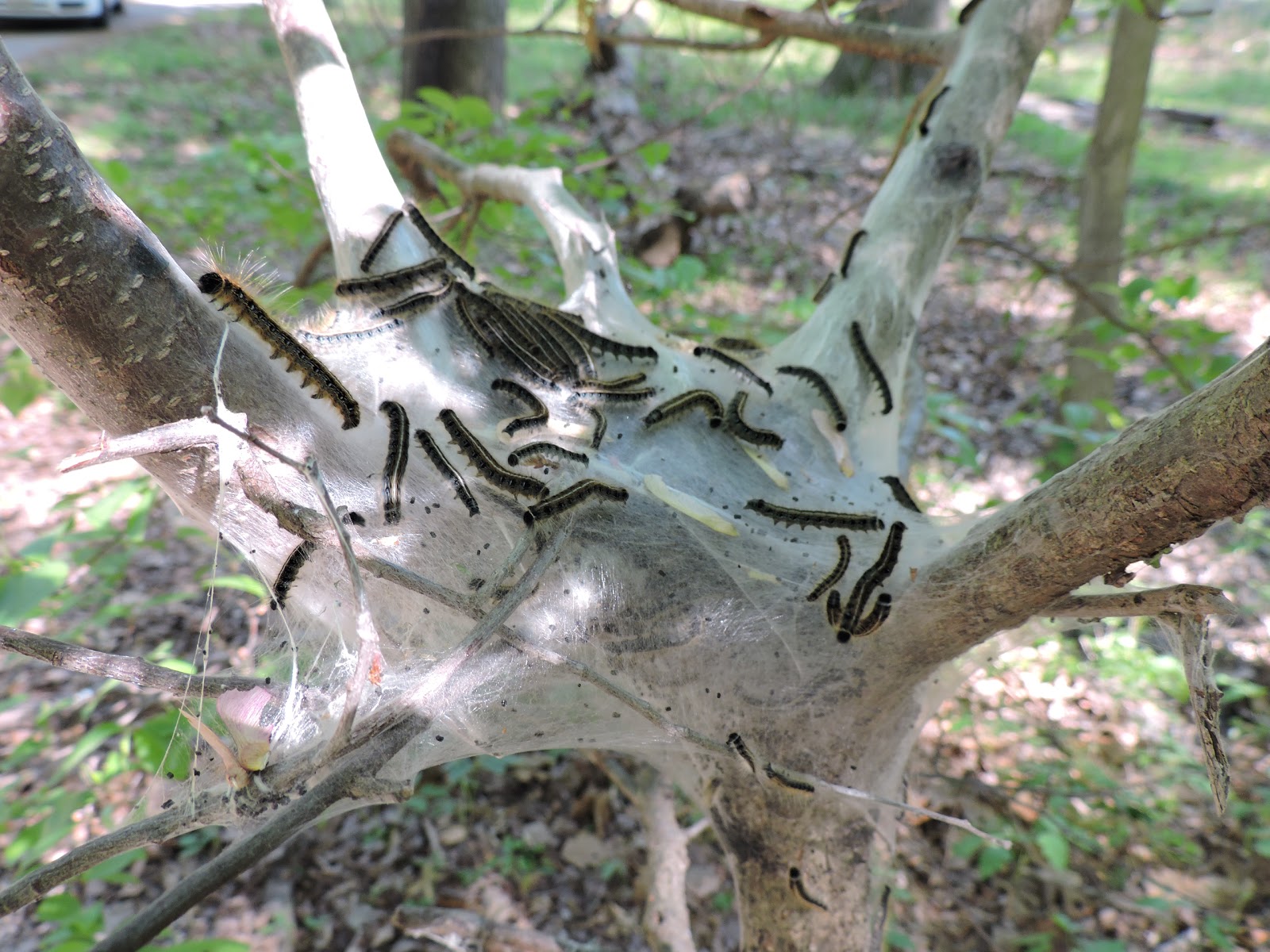
An Eastern Tent Caterpillar nest on a cherry. The dots are frass, or caterpillar poop.

    The web nests of Eastern Tent Caterpillars (Malacosoma americana) are easily visible on woody plants of the Rose family, especially cherry trees, in the spring. If you see a web nest in the woods during spring around here, it's a pretty good bet you have a Wild Black Cherry for example. 

A newly born Eastern Tent caterpillar, 1st instar.

     The caterpillars emerge rather early in the year and form their web tents where they are safe from many predators who are unable or prefer to not try to get through the thick webs full of frass (insect poop). The caterpillars also likely sequester cyanide from the cherry they feed on and have somewhat irritating hairs to also protect them. They tend to feed at night to avoid even more potential enemies. Despite all these defenses, Cuckoos and some wasps still get their share of them. Although numerous, the caterpillars feed early enough in the year to allow their host plants to recover, having evolved with them so that they rarely cause any real harm to the native trees they feed on. It of course makes poor evolutionary sense to permanently kill off the plants you need to survive. They can however sometimes damage to nonnative cherries that did not evolve with them, though that's usually uncommon as well. 

An Eastern Tent caterpillar wandering off to find a place to form a cocoon and pupate.

     Right about late May or very early June, the caterpillars finish feeding and go on a walk-about looking for a place to form their white, web-covered cocoons. This is when many people notice them crossing roads and trails and make the assumption they are Gypsy Moths. Though similar, the Gypsy Moth caterpillars are smaller this time of year, with big-looking heads in proportion to their bodies and mostly lacking the blue marks along their sides that Eastern Tent Caterpillars have. 

Eastern Tent cocoon

     Tent Caterpillar cocoons are a favorite target of some birds, with Blue Jays being very adept at finding them, picking through the web and hair-covered outer layer to get to the developing moth pupae inside. The very hairy, brown moths with two light-colored lines that emerge are otherwise rather drab looking. They appear mostly in late June around our region and quickly search for cherry trees and other members of the Rose family to lay their eggs upon to start the cycle all over again.

An Eastern Tent egg mass on a cherry branch.

     By the way, Forest Tent Caterpillars are also often confused for Eastern Tent Caterpillars and are active about the same time. These do not form any web tents, prefer deeper woods, and have an interesting pattern on their backs that look like penguins all standing on top of each other. They tend to also stay in groups, particularly when young.

A Forest Tent caterpillar showing the penguin-like marks on its back.